- Jean Casella is the director and co-founder of Solitary Watch. She has also published work in The Guardian, The Nation, and Mother Jones, and is co-editor of the book Hell Is a Very Small Place: Voices from Solitary Confinement. She has received a Soros Justice Media Fellowship and an Alicia Patterson Fellowship.
Patrick Booth is a Managing Attorney at the Prison Law Office (PLO). Patrick joined the Prison Law Office as a summer intern in 2018. He began full-time at the PLO as a Jane Kahn Legal Fellow in September 2019, and he became a Staff Attorney in September 2021. He works on a variety of issues at PLO, including on several cases and projects aimed at reducing the use of solitary confinement in county jails, holding staff accountable for committing misconduct, and ensuring that people with disabilities have equal access to programs and services in prisons and jails. He received his B.A. from U.C. Berkeley in Integrative Biology in 2013 and his J.D. from Berkeley Law in 2019. At Berkeley, Patrick helped with the representation of death row clients while working in Berkeley’s Death Penalty Clinic, and he provided free legal assistance to low income and unemployed residents of the Bay Area in the law school’s Workers’ Rights Clinic. Patrick also served as a summer clerk at the Oregon Innocence Project in 2017.
- Bonnie Tenneriello is Solitary Confinement Project Director and a Senior Attorney with Prisoners’ Legal Services of Massachusetts. Much of her litigation has focused on solitary confinement, including the pending case Evelyn v. DOC, which challenges the Massachusetts DOC’s evasion of solitary confinement reform. She has also written on this topic for the Boston Review. Recent litigation also includes Doe v. Mici, which challenges the use of prisons to house people civilly committed for substance use disorder. She serves on the Board of Directors of the Massachusetts Chapter of the National Lawyers Guild.
Daryl Norcott is Amend’s Director of Community Partnerships and Special Projects. He is responsible for developing programs and engaging a growing number of community partners and allies on long-term culture change strategies in U.S. prisons. In 2021, Daryl launched the Amend Ambassadors leadership program, an initiative that provides advanced training in Amend’s health-focused methodologies and professional development opportunities in education, facilitation, and public speaking. From 2023-2025 he served as a member of Justice Reinvented, a group of community organizations and academic centers dedicated to reimagining California’s prison system. He currently directs Amend’s “Cell-2-Cell” program, a network of virtual exchanges connecting people incarcerated in the U.S. and Europe through facilitated video conferences. Daryl brings over twenty years of experience in policy analysis, government, and community building to his work at Amend. He lives in the Bay Area with his family.
Amend is a non-profit program based at the UCSF School of Medicine. We are a physician-led team with expertise in public health, criminal justice, corrections, the law, research and program evaluation, and organizational change. Through thought leadership, program development, and on-the-ground training, we draw on international models and public health practices to transform U.S. carceral facilities from institutions of isolation and punishment to centers of rehabilitation, health, and humanity.

Prison Law &
Advocacy Conference
November 5-7, 2026
Prison Law &
Advocacy Conference
November 5-7, 2026
Prison Law &
Advocacy Conference
November 5-7, 2026
Explore the Panels
Explore the Panels
Advancing Higher Standards of Medical Care for Incarcerated People Through Partnership with Community Providers
This session will focus on efforts in Boston to engage community clinicians to improve medical care for incarcerated people, and in some cases, to effectuate their liberty.


Panelist Biographies
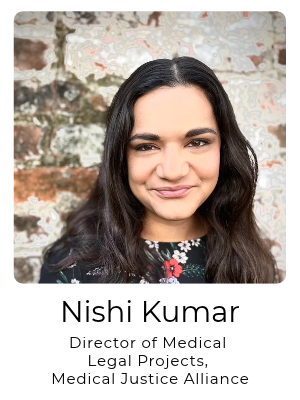
- Nishi Kumar is the Director of Medical Legal Projects at the Medical Justice Alliance, a non-profit organization of volunteer medical professionals that protects the right to medical care for every person incarcerated. Nishi is an experienced civil rights attorney and was most recently the Director of Civil Litigation at the Promise of Justice Initiative in New Orleans, Louisiana. There, she advocated on behalf of and alongside currently and formerly incarcerated people throughout Louisiana, specifically at the intersection of mass incarceration and healthcare. She was previously an adjunct professor at Loyola Law School, where she co-taught an incarceration seminar. Nishi graduated from NYU Law School, where she was a Hays Civil Liberty fellow, a Notes Editor on the NYU Law Review, and co-chair of the South Asian Law Students Association. After law school, she clerked for Judge Paul Watford on the Ninth Circuit and Judge Jesse Furman on the Southern District of New York.
Nicole Mushero is a geriatrician at Boston Medical Center. Nicole received a PhD in biochemistry at Brandeis University before attending UMass for medical school. Nicole went to Cambridge Health Alliance for residency and fellowship before coming to Boston Medical Center and serving as a nursing home physician. Nicole also holds a faculty appointment at the medical school as an assistant professor of medicine.
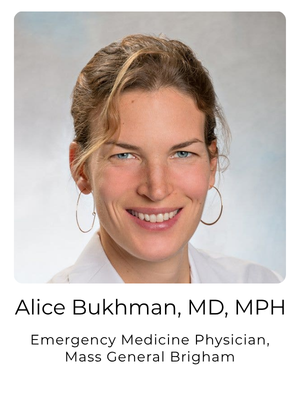
- Alice Bukhman is a Physician at Mass General Brigham who specializes in Emergency Medicine.
- Christopher Manz is Chief Medical Officer of Traversal Health and a medical oncologist dedicated to improving cancer care for justice-involved populations. Previously, he practiced at Dana-Farber Cancer Institute and Brigham and Women’s Hospital, where his research focused on reducing disparities in cancer outcomes through innovative care delivery models. Dr. Manz earned his medical degree, completed his residency and fellowship training, and received a Master of Science in Health Policy Research from the University of Pennsylvania. His work combines clinical expertise, health policy research, and operational leadership to expand access to high-quality oncology care within correctional settings.
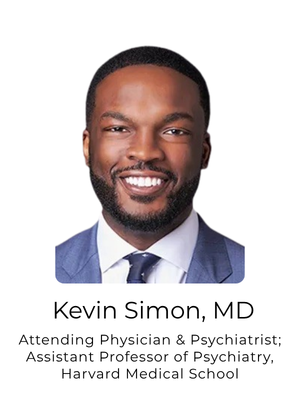
Kevin Simon is a child and adolescent psychiatrist and addiction medicine specialist whose work spans clinical care, medical education, and public health leadership. He is triple board-certified in child and adolescent psychiatry, adult psychiatry, and addiction medicine, and serves as the inaugural Chief Behavioral Health Officer for the City of Boston.
At Boston Children’s Hospital, Dr. Simon is a physician within the Division of Addiction Medicine, the first program of its kind at a children’s hospital in the United States. He provides comprehensive psychiatric care to youth and young adults across emergency, inpatient, and outpatient settings, with a focus on substance use disorders, trauma-related conditions, mood and anxiety disorders, attention-deficit/hyperactivity disorder (ADHD), and complex co-occurring presentations.
Dr. Simon is also the Director of the JUSTICE (Juvenile Understanding and Support Through Intervention, Community, and Empowerment) Clinic, where he works at the intersection of behavioral health and public systems, including juvenile justice, child welfare, and education. His clinical approach often involves cross-system collaboration and the development of tailored care plans that align with the realities of young people’s lives.
An Assistant Professor of Psychiatry at Harvard Medical School, Dr. Simon teaches and mentors medical trainees, emphasizing the importance of understanding the social and structural factors that shape health, including family context, school environments, housing stability, and access to care. His academic work and writing focus on advancing equitable and culturally responsive approaches to mental health and substance use treatment.
His research and clinical leadership are dedicated to improving the prevention, identification, and treatment of substance use disorders in adolescents, particularly among underserved and system-involved youth. Across his roles, Dr. Simon is committed to delivering high-quality, evidence-informed care that is both rigorous and deeply attentive to the individual.
CLE Materials
- Gabriel Dayanim et al., Nursing Home Availability for Incarcerated Persons Granted Compassionate Release, Sci. Rep. (Oct. 2025)
- Christopher R. Manz et al., Correctional Health and Oncologist Perspectives on Strategies to Improve Cancer Care in US Prisons, JAMA (Oct. 15, 2025)
- Nicole Mushero et al., Introducing Residents to Advocacy for Aging Incarcerated People: A Compassionate Release Pilot Elective, J. Am. Geriatric Soc’y (Aug. 2026)
- Nicole Mushero et al., End-of-Life and Hospice Care for People Who Are Incarcerated, JAMA (Aug. 2026)
- Nicole Mushero et al., Compassionate Release Reform-Moving Medical Parole to Medical Professionals, JAMA (Nov. 2025)
- Narcissa Plummer et al., Racial Differences in Self-Report of Mental Illness and Mental Illness Treatment in the Community: An Analysis of Jail Intake Data, Admin. & Pol’y Mental Health & Mental Health Servs. Res. (Sep. 2023)
- Michelle Suh et al., Key Characteristics of Medical Parole Applications in Massachusetts in 2022-2023, Sci. Rep. (Nov. 2025)
Advocacy and Practice Strategies for Improving Mental Health Care and Equity for Incarcerated People
This session engages legal, clinical and non-litigation advocacy strategies to improve mental health care and to ensure that incarcerated people with serious mental illness have equal access to programming, parole, and liberty.
Panelist Biographies
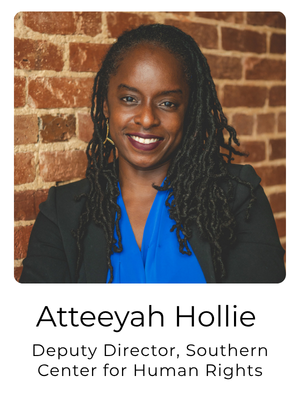
- Atteeyah Hollie is the Deputy Director of Southern Center for Human Rights (SCHR) where she has litigated cases challenging the denial of the right to counsel for people experiencing poverty, illegally closed courtrooms, wealth-based detention, inhumane prison conditions, and the denial of utility services because of court debt. In addition, Atteeyah has teamed up with other SCHR attorneys to establish the office’s practice of challenging extreme prison sentences in the deep South. Atteeyah is grateful to call Otis and Clive Stone her sons, and Nate, her loving husband.
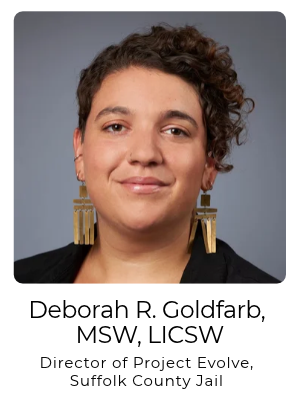
- Deborah (Deb) Goldfarb has worked in the social services field for over 10 years with diverse patient populations throughout the Greater Boston Area. As a case manager and clinical social worker she has focused on social determinants of health as well as those experiencing acute psychiatric crises, trauma, houselessness, and addiction. In recent years her work has concentrated on the intersection of behavioral health care and the criminal legal system through work in the state prison system and with Harvard Law’s Criminal Justice Institute. Currently she works with Grayken Center for Addiction on initiatives related to the criminalization of addiction. She is a passionate advocate for those facing social injustices. She leads the National Association of Social Workers- MA Chapter’s Criminal Justice Committee, is a board member with the Criminal Justice Policy Coalition, and teaches part time at Boston University School of Social Work.
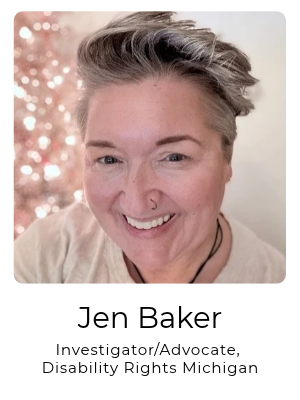
- Jen Baker is an Investigator-Advocate with Disability Rights Michigan (DRM), part of the federally mandated Protection & Advocacy System. Based in the Community and Institutional Rights division, she is the dedicated investigator-advocate for disability-related issues within the Michigan Department of Corrections (MDOC). Jen investigates reports of abuse, neglect, wrongful death, as well as issues related to appropriate treatment, access, accommodations, and conditions for individuals with mental or physical disabilities in MDOC custody. Her knowledge of prison reform and disability advocacy is informed by six years of prior experience as a Corrections Officer in MDOC.
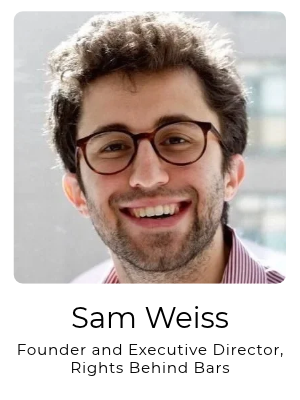
- Sam Weiss is the Founder and Executive Director of Rights Behind Bars. Before starting Rights Behind Bars, Sam litigated prison conditions cases and other civil rights cases across the country at the ACLU’s National Prison Project, the Southern Poverty Law Center, and the Lawyers’ Committee for Civil Rights Under Law. He has published writing on the criminal justice system and other issues of civil and constitutional rights in academic and popular settings. He is a Lecturer on Law at Harvard Law School where he teaches the doctrinal course Prison Law.
CLE Materials
- Jennifer Wyatt Bourgeois et al., A State-by-State Analysis of Legislative Frameworks for Mental Health Programming in Correctional Facilities, Crim. Justice Pol’y Rev. (2026)
- Dragana Derlic et al., Examining the Relationship Between Mental Health Diagnoses and Write-Ups During Incarceration, Crime & Delinq. (2024)
- Sabrina Giguere et al., Association between mental illness and disciplinary confinement and its effect on mental health: A systematic review and meta-analysis, PLoS One (2025)
- Kimberly Houser et al., Mental Health Risk Factors and Parole Decisions: Does Inmate Mental Health Status Affect Who Gets Released, Int’l J. Environ. Res. Public Health (2019)
- Bella Magner-Parsons et al., Self-harm in prison: moving towards contextual understanding, Front. Psych. (2026)
Comment: Crowell v. Massachusetts Parole Board, 74 N.E.3d 618 (Mass. 2017), 131 Harv. L. Rev. 910 (2018) [Massachusetts Supreme Judicial Court Observes that Americans with Disabilities Act Applies to Parole]
AI in the Carceral State: Perils and Promise
Artificial intelligence is arriving in the carceral system from two directions at once. On the perils side, prisons, jails, and immigration detention are rapidly deploying algorithmic and surveillance tools: “risk-assessment” and classification systems that shape custody, parole, and release decisions; voice-print and communication-monitoring systems layered onto prison phone and messaging networks; face recognition; electronic monitoring and “e-carceration”; and automated systems that calculate—and miscalculate—good-time, sentence, and benefits eligibility, often built and operated by private vendors and shielded from scrutiny. On the promise side, the same technology may give under-resourced advocates and incarcerated litigants new leverage—accelerating legal research, surfacing patterns across records and grievances, and helping pro se and jailhouse litigants navigate complex doctrine. Bringing together litigators challenging carceral algorithms and surveillance, scholars of AI in the criminal-legal system, and builders of AI tools for the defense side, this panel will map where AI is already reshaping prisoners’-rights work, the new harms and defenses it creates, and how advocates can both resist its abuses and responsibly harness it.


Panelist Biographies
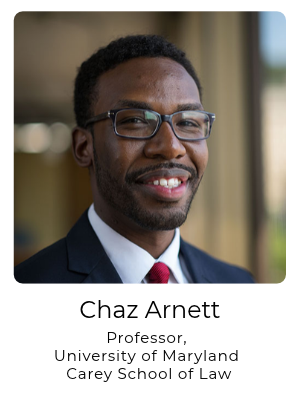
- Chaz Arnett is the Jacob A. France Professor of Law at the University of Maryland Francis King Carey School of Law. His research examines race, digital technologies, and the criminal legal system, including how surveillance technologies perpetuate racial inequities in policing and corrections. His scholarship addresses artificial intelligence, electronic monitoring, and privacy. Before entering academia, he worked as a public defender in Baltimore and New Orleans and as a staff attorney at the Advancement Project, where he supported efforts to challenge the school-to-prison pipeline. He earned his J.D. from Harvard Law School and his B.A. from Morehouse College.
Devshi Mehrotra is the co-founder and CEO of JusticeText, which develops software to help public defenders review and organize audiovisual evidence, including body camera footage, interrogation recordings, and jail calls. She and co-founder Leslie Jones-Dove began the project as computer science students at the University of Chicago, working with the Cook County Public Defender’s Office. Her previous work includes artificial intelligence research at Google Brain, Microsoft Research, Peking University, and Stanford Law School. She earned bachelor’s and master’s degrees in computer science at the University of Chicago and a master’s in global affairs at Tsinghua University as a Schwarzman Scholar. Her work reflects a commitment to using technology to improve access to justice and expand opportunities for underserved communities.
- Gideon Epstein is Policy Counsel in the ACLU of Massachusetts’ Technology for Liberty Program, where his work addresses civil liberties, surveillance, data privacy, and artificial intelligence. He advocates for democratic oversight of surveillance technologies and safeguards against government tracking. His work includes analysis of license plate reader networks and AI-powered policing, and efforts to equip criminal defense attorneys to uncover law enforcement’s use of surveillance tools through the ACLU’s Surveillance Discovery Project. He previously worked as a voting rights organizer at the Lawyers’ Committee for Civil Rights Under Law. In 2025, he received the George Washington University Law School’s Justice Thurgood Marshall Civil Liberties Award.
Shlomo Klapper founded Learned Hand, an artificial intelligence company that develops tools for judges and court staff. Clio acquired Learned Hand in September 2026. His work focuses on adapting AI to judicial tasks, including reviewing case materials, conducting research, and preparing bench memoranda and draft orders. Before founding the company, he clerked for Judge Steven J. Menashi of the U.S. Court of Appeals for the Second Circuit, litigated commercial disputes at Quinn Emanuel Urquhart & Sullivan. He also conducted behavioral research at Duke University. He earned a J.D. at Yale Law School and graduated summa cum laude from the University of Pennsylvania, with degrees in economics from Wharton and European history.
CLE Materials
- Chaz Arnett, From Decarceration to E-Carceration, 41 Cardozo L. Rev. 641 (2019)
- Colleen V. Chien & Miriam Kim, Generative AI and Legal Aid: Results from a Field Study and 100 Use Cases to Bridge the Access to Justice Gap, 57 Loy. L.A. L. Rev. 903 (2025)
- Zina Makar, The Datafication of Incarceration, 135 Yale L. J. 2451 (2026)
- Ngozi Okidegbe, Discredited Data, 107 Cornell L. Rev. 2007 (2022)
Alternatives to Solitary Confinement
What is working to end the use of solitary confinement across the country? What lessons can we learn from international perspectives? How do we pilot, seed, and expand programs that present viable alternatives?
Panelist Biographies
CLE Materials
- Ashker et al. v. Gavin Newsom et al., 81 F.4th 863 (9th Cir. 2023) [Motion for Leave to File Brief of Amici Curiae]
- Jules Lobel, The Liman Report and Alternatives to Prolonged Solitary Confinement, 125 Yale L. J. F. 238 (2016)
- Mays et al. v. Cnty. of Sacramento, No. 2:18-cv-02081 (E.D. Cal. May 16, 2019) [Plaintiffs’ Motion for Partial Summary Judgment or Preliminary Injunction]
- Practices and Principles for Remedial Measures Regarding the Use of Segregation in County Jails
- Reimagining San Quentin: Recommendations to Transform San Quentin State Prison into a Rehabilitation Center (Jan. 2024)
- Bonnie Tenneriello, Prison Reform’s Shell Game, Boston Review (July 2024)
- Edward Tie, “After Decades in Solitary, a Sliver of Light,” Solitary Watch (June 24, 2025)
- Sara Vogel, Fact Sheet: Solitary Confinement and Prison Safety, Solitary Watch (Feb. 2023)
Attacks on the Rights and Legal Protections of Incarcerated LGBTQ+ People
In this session, we will discuss new challenges from federal and state governments to undermine and eliminate constitutional and statutory protections of LGBTQ+ people in prisons and jails and how litigators and advocates are fighting back to preserve, expand, and enforce those rights. The panel will discuss how the legal landscape for the rights of LGBTQ+ people has changed over the past decade, starting with the first Trump Administration (2016) to now, including attempts by states to categorically prohibit health care for the treatment of gender dysphoria, proposals to eliminate protections under the Prison Rape Elimination Act (“PREA”), proposals to exclude gender dysphoria as a disability under the Americans with Disabilities Act (“ADA”), and Supreme Court cases on transgender rights.
We will discuss litigation under the Eighth Amendment and Equal Protection Clause of the Fourteenth Amendment, state court litigation, the use of the Administrative Procedure Act against proposed changes to federal law, and potential claims under the ADA. We will also discuss new advocacy tools for decarceration and jury voir dire.
Panelist Biographies
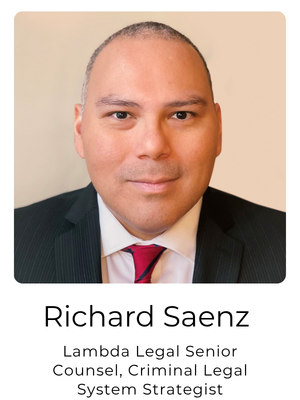
- Richard Saenz (he/him) is Senior Counsel and the Criminal Justice and Police Misconduct Strategist at Lambda Legal, the oldest and largest national legal organization committed to achieving full recognition of the civil rights of LGBTQ+ people and those living with HIV. He is the project manager and co-author of Protected & Served? 2022, Lambda Legal’s groundbreaking community survey on the experiences of LGBTQ+ people and people living with HIV with the criminal legal system.
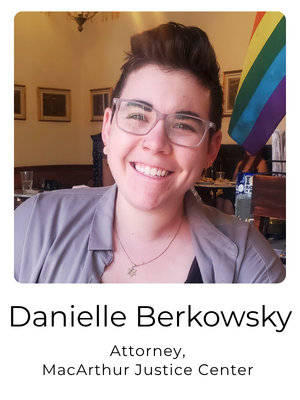
Currently, Richard is lead counsel in Tucker et al. v. Utah Department of Corrections, et al., a challenge to the state of Utah’s categorical ban on medically necessary care for incarcerated people with gender dysphoria in Utah’s prisons and discriminatory treatment because of their disability of gender dysphoria. As lead counsel in Wagoner v. Winkelman, he secured a federal district court win, after a five-day trial, finding that gender-affirming surgery is medically necessary treatment for Ms. Wagoner’s gender dysphoria and that DOC had acted with deliberate indifference to her gender dysphoria in violation of the Eighth Amendment’s prohibition on cruel and unusual punishment [continued in link above…] - Danielle Berkowsky (she/her) is a civil rights attorney at the MacArthur Justice Center, where she advocates on behalf of incarcerated individuals, victims of police violence, and people in immigration detention. Danielle’s prisoners’ rights practice focuses on advocating for incarcerated transgender women, challenging the use of solitary confinement, and representing the families of individuals who lost their lives in custody. Danielle also seeks to hold law enforcement accountable through litigation on police shootings, K9 attacks, and false arrests, as well as through FTCA claims against federal immigration agents. Danielle joined MJC after finishing a fellowship in prisoners’ rights at Uptown People’s Law Center.
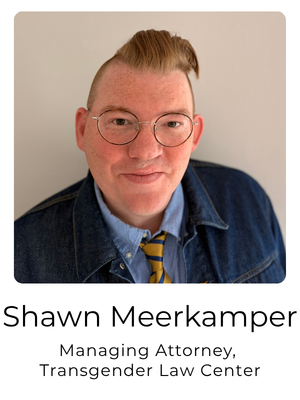
- Shawn Thomas Meerkamper (they/them) is the Managing Attorney at Transgender Law Center, the largest national, trans-led organization working to set all people free. At TLC, they have litigated trans prisoners’ rights cases against the California, Colorado, and federal prison systems, worked to pass state legislation to make incarcerated trans women safer, and negotiated trans policies with local jails and state prisons. They are a part of the team in Kingdom v. Trump, which so far has prevented to Trump Administration from forcibly de-transitioning transgender people in the custody of the Federal Bureau of Prisons. Shawn lives in Durham, North Carolina, with their spouse, four cats, and five chickens.
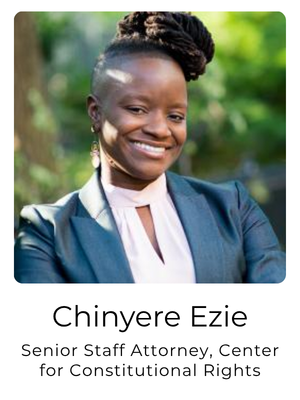
Chinyere Ezie (she/her) is a Senior Staff Attorney at the Center for Constitutional Rights, where she advocates for racial and gender justice; Lesbian, Gay, Bisexual, Transgender, Queer, and Intersex (LGBTQI) rights; and challenges governmental abuses of power.
Prior to joining The Center for Constitutional Rights, Chinyere was a Staff Attorney at the Southern Poverty Law Center, where she brought cases defending the rights of LGBTQI Southerners, including trans prisoners’ rights activist Ashley Diamond. She also served as a Trial Attorney at the U.S. Equal Employment Opportunity Commission where she litigated employment discrimination cases and secured a $5.1 million jury verdict on behalf of workers who were subjected to religious harassment.
Chinyere is a William J. Fulbright Scholar and a graduate of Yale University and Columbia Law School, where she was an Alexander Hamilton Scholar and served as Editor in Chief of the Journal of Gender and Law. In 2016, Chinyere was recognized as one of the nation’s Best LGBT Lawyers Under 40.
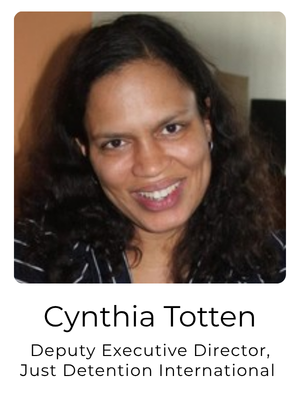
Cynthia Totten (she/her) leads Just Detention International’s national training and technical assistance program, supporting the work of state and tribal sexual assault coalitions, victim advocates, corrections officials, and funding administrators to ensure that incarcerated survivors have access to confidential crisis services. Additionally, she works with corrections agencies on adopting policies that keep prisoners safe from sexual abuse. A lawyer with over two decades of experience in human and civil rights work, Cynthia also advocates to bring basic international human rights standards into U.S. prisons and jails and contributes to JDI’s policy and international programs.
CLE Materials
- A Community Survey of LGBTQ+ People and People Living with HIV, Protected & Served? (2022)
- Avoiding Anti-Transgender Bias in Jury Selection: A Voir Dire Guide for Lawyers, Lambda Legal
- Chandler v. Macomber, 2026 WL 799916 (E.D. Cal., 2026) [Order Granting Second Motion to Dismiss]
- Chandler v. California Department of Corrections and Rehabilitations, 2024 WL 2153890 (E. D. Cal., 2024) [Order Granting First Motion to Dismiss]
- Chinyere Ezie, Dismantling the Discrimination-to-Incarceration Pipeline for Trans People of Color, 19 U. St. Thomas L. J. 276 (2023)
- Jordan Grasso & Caro Mooney, The Role of Police Perceptions of Gender Variation in California Police Stops, Criminology (2026)
- Incarceration Rates and Traits of Sexual Minorities in the United States, Williams Institute (2017)
- Raven, et al. v. Polis, et al., No. 19-cv-34492 (Colo. Dist. Ct. Nov 22, 2019) [First Amended Complaint]
- Richard Saenz, A Crisis Behind Bars: Legal Issues Impacting Transgender People in Prisons, ABA: Criminal Justice (2024)
- Transgender Decarceration Guide: Representing Gender Expansive People in Federal Criminal and Post‑Conviction Cases, The LGBTQ+ Advocacy Clinic at Harvard Law School
- Wagoner v. Winkelman (D. Alaska)
- Trial Court Findings of Fact and Conclusions of Law (Sept. 26, 2025)
- Williams v. Kincaid, 45 F.4th 759 (4th Cir. 2022)
Bringing Creativity and Tenacity to Prison/Jail Investigations
This session examines one of the most important phases of any case challenging human rights abuses on the inside — investigations. Panelists will include investigators, formerly incarcerated litigators, paralegals, and attorneys who will walk through the nuts and bolts of effective investigation at all stages of litigation (i.e. when you’re deciding whether to sue, discovery, monitoring, enforcement), why trusting relationships with people on the inside and families are vital to every effort (and how to build them in civil rights litigation), how to use the many tools at our disposal to unearth the information we need, and how to be creative, persistent, and client-centered through it all.
Panelist Biographies
- Atteeyah Hollie is the Deputy Director of Southern Center for Human Rights (SCHR) where she has litigated cases challenging the denial of the right to counsel for people experiencing poverty, illegally closed courtrooms, wealth-based detention, inhumane prison conditions, and the denial of utility services because of court debt. In addition, Atteeyah has teamed up with other SCHR attorneys to establish the office’s practice of challenging extreme prison sentences in the deep South. Atteeyah is grateful to call Otis and Clive Stone her sons, and Nate, her loving husband.
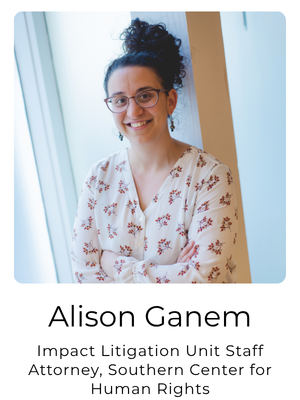
Ali Ganem is an attorney in the Impact Litigation Unit at the Southern Center for Human Rights, where she works on cases challenging inhumane prison and jail conditions, abusive police conduct, and other injustices of the criminal legal system. She also works on state and federal post-conviction cases on behalf of people serving unjust sentences in Georgia and Alabama. Prior to joining the Southern Center for Human Rights in 2020, Ali worked at the Equal Justice Initiative (EJI), where she represented death-sentenced individuals in Alabama on direct appeal and in state post-convictions proceedings. Ali was born and raised in the San Francisco Bay Area, earned her J.D. from the University of California Berkeley School of Law, and is an avid fan of the Golden State Warriors basketball team.
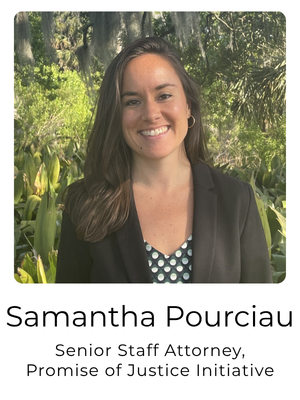
Samantha (Sammy) Pourciau is a Senior Staff Attorney on the civil litigation team at the Promise of Justice Initiative. Before receiving her J.D. from New York University School of Law in 2021, she worked at the Promise of Justice Initiative for four years, first as an Avodah Jewish Service Corps member coordinating PJI’s Client and Family Assistance Program, and then as a paralegal and outreach coordinator. She received her B.A. from Tulane University in Sociology and Social Policy & Practice in 2014. She serves on the Board of Directors for Avodah.
During law school, she was a student advocate with the Office of the Appellate Defender through NYU’s Criminal Appellate Defender Clinic and with the Brooklyn Defender Services through NYU’s Criminal Defense and Reentry Clinic, as well as a volunteer with the Parole Preparation Project. Over the summers, she interned at the ACLU’s Criminal Law Reform Project and the Southern Center for Human Rights. She served on the board of the N.Y.U. Review of Law & Social Change as an Executive Editor.
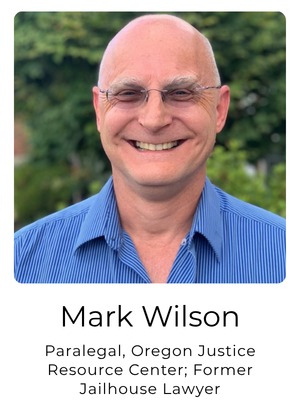
- Mark Wilson has worked as a paralegal for the Oregon Justice Resource Center since January 2025. Mark was incarcerated for 37½ years for a crime he committed as a teenager. While incarcerated, Mark taught himself the law and completed law classes that were available to him. From 1989 until his release in January 2025, Mark assisted other incarcerated people in accessing state and federal courts to challenge their convictions and sentences and the conditions of their confinement. He has extensive knowledge of prison litigation issues, post-conviction relief proceedings, state and federal habeas corpus proceedings, direct appeal, parole proceedings and appeals, and many other issues arising within the prison system. Mark was a contributing writer for Prison Legal News and Criminal Legal News from 1998 until 2025. He was also one of the first two incarcerated people to serve on a Legislative Workgroup when Senator Michael Dembrow appointed him to serve on a Legislative Workgroup on Prison Education from 2019-2025.
Among the many lawsuits he brought or helped other people bring, Mark successfully brought a federal class action lawsuit against prison officials for refusing to treat more than 5,000 incarcerated people who suffered from hepatitis C in 2001. This multimillion-dollar lawsuit forced prison officials to allow a panel of outside experts to rewrite the Oregon Department of Corrections’ Hepatitis C policies and start treating HCV infected prisoners. For more detailed information about this suit and some of Mark’s other efforts during his incarceration, see “How Oregon’s Prison System Retaliated Against Its Most Effective Jailhouse Lawyer,” Jessica Schulberg, Huffington Post, (April 25, 2022); and “Prominent Legal Advocate to be Freed After 37 Years in Prison,” Jessica Schulberg, Huffington Post, (September 30, 2024). In addition to his work at OJRC, Mark helps formerly incarcerated people with their transition back into the community, helping them find housing, employment and other resources they need to survive and thrive within the community.
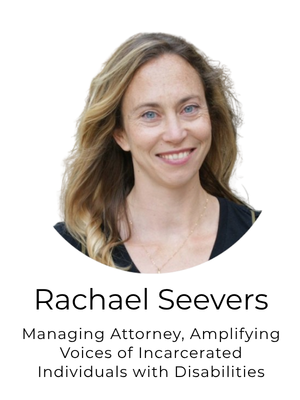
Rachael Seevers joined Disability Rights Washington as an attorney in 2013 and has been a program attorney for the Amplifying Voices of Incarcerated Individuals with Disabilities (AVID) Program since 2014. She is currently the managing attorney of the AVID program. Her work with AVID focuses on individual and systemic advocacy in Washington’s state prisons and the Special Commitment Center. Rachael also engages in routine and targeted monitoring in these correctional and treatment settings as well as policy advocacy at the state level to effect larger criminal justice reform in Washington. Prior to coming to DRW, Rachael worked at Mental Hygiene Legal Service, a public interest legal organization in New York dedicated to protecting and advancing the rights of people with mental illness. Rachael’s work there ranged from individual appeals concerning involuntary commitment and medication, to civil rights litigation relating to the provision of care for people with mental illness.
CLE Materials
- VOTE et al. v. LeBlanc et al., No. 23-cv-01304 (M.D. La. 2025)
- Declaration of Ray Faria (Sept. 30, 2024)
- Declaration of Patrick Jones (Sept. 30, 2024)
- Declaration of Chadarius Morehead (Sept. 30, 2024)
- Supplementary Declaration of Joseph Guillory (Sept. 30, 2024)
- Supplementary Declaration of Damaris Jackson (Sept. 30, 2024)
- Supplementary Declaration of Darrius Williams (Sept. 30, 2024)
- Anstett et al. v. Oregon et al., No. 3:01-cv-1619 (2002)
- Class Certification Order (Dec. 19, 2002)
- Monitoring Order (Apr. 18, 2004)
- Settlement (Apr. 2, 2004)
- Expert Panel Report (Apr. 6, 2007)
- Gumm et al. v. Ford et al., No. 5:15-cv-00041 (M.D. Ga. 2019) [Final Order and Permanent Injunction]
Carceral Data
This session will discuss a range of investigatory tools for and challenges encountered in extracting information from carceral institutions prior or adjacent to litigation. In particular, it will focus on the use of public records and other transparency laws, and discuss efforts to build datasets related to mortality, solitary confinement, and violence.
Panelist Biographies
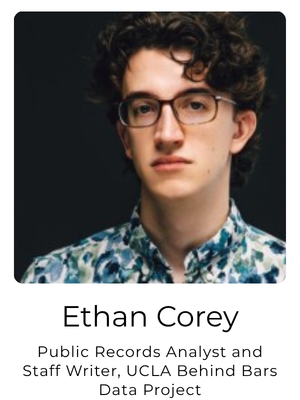
- Ethan Corey is a public records analyst and staff writer at UCLA Law’s Behind Bars Data Project, where he works on collecting, verifying, and analyzing records of deaths in custody nationwide. Previously, he was Research & Projects Editor at The Appeal, where he led records and data reporting projects, including a national database of prison commissary prices and a multiyear effort to obtain federal death-in-custody records. His work focuses on using public records and data to investigate conditions in prisons and jails and make information about the criminal legal system more accessible.
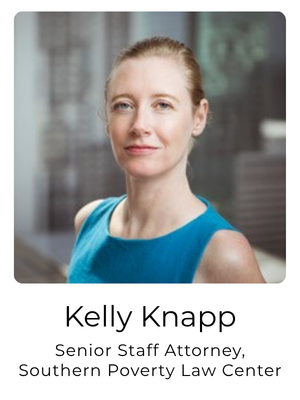
- Kelly Knapp is a Senior Staff Attorney in the Miami office of the Southern Poverty Law Center. At the SPLC, she has litigated or led complex investigations about Florida’s use of long-term solitary confinement, systemic excessive force and failures to protect, PFAS-contaminated prison drinking water, pay-to-stay liens, and delayed competency restoration services for pretrial detainees with serious mental illness. Previously, at the Prison Law Office, Kelly led investigations or brought suit against several California county jails about inadequate healthcare, systemic violence, and solitary confinement. She also helped litigate and monitor Plata v. Brown (inadequate medical care) and Armstrong v. Davis (disability accommodations). Before law school, Kelly worked for several years as a discharge planner for people with psychiatric disabilities leaving the San Francisco County Jail. She is a graduate of UCLA Law’s Epstein Program in Public Interest Law & Policy and Critical Race Studies Program.
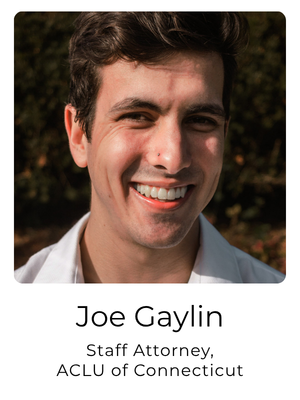
- Joe Gaylin is a Staff Attorney at the ACLU of Connecticut. His work touches on a range of civil liberties issues, including conditions of confinement, youth parole, decarceration, and state constitutionalism. Before law school, Joe worked on a campaign to end the use of solitary confinement in state prisons and jails. In that role, he helped pass the PROTECT Act—legislation that restricted the use of solitary confinement, created a correction ombuds, and mandated data collection on conditions of confinement.
Joe holds a J.D. from UCLA School of Law, with a specialization in critical race studies and public interest law and policy. In law school, he authored a report on conditions in California state prisons during the Covid-19 pandemic and served as an Articles Editor on UCLA Law Review. Joe is also the author of Abolishing Carceral Data, 72 UCLA L. REV. 1244 (2026). Joe served as a law clerk for Judge Sarah E. Geraghty of the U.S. District Court for the Northern District of Georgia. He holds a B.A. in Ethnicity, Race, and Migration from Yale University.
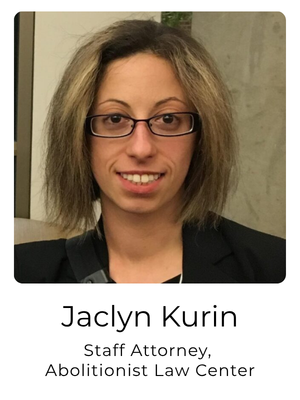
- Jaclyn Kurin (she/her) is an ALC staff attorney, barred in Washington, D.C. She received her J.D. from George Mason Law School in 2016 and her LL.M. from UCLA Law School in 2019, where she specialized in criminal justice. She also earned a master’s in advocacy journalism from Georgetown University in 2010. Kurin has worked at a civil rights employment law firm and interned at Fair and Just Prosecution and the Office of the Public Defender in Rockville, MD. For several years, she volunteered at Offender Aid Restoration and taught classes to inmates at the Arlington County Detention Center in Virginia. Kurin also has published several law journal articles on prison reform, bail, and police misconduct. Additionally, Kurin worked at a Los Angeles civil rights law firm, where she helped establish a new claim for suing the police, which has been recognized in federal court. Kurin’s work at ALC focuses on pursuing claims against the Allegheny County Jail for its treatment of incarcerated community members.
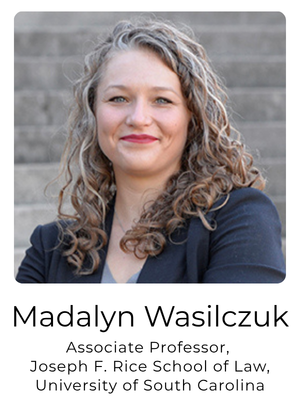
Madalyn K. Wasilczuk is a Professor of Law at the University of South Carolina Joseph F. Rice School of Law. Her work focuses on criminal legal system issues, including policing, race, extreme sentencing, conditions of confinement, and the prosecution and detention of children and pregnant people. She directs the Youth Defender Clinic and teaches 8th Amendment Law & Litigation, Criminal Adjudication, and a Juvenile Justice Seminar.
Professor Wasilczuk’s scholarship appears in publications such as the Georgetown Law Journal, Wisconsin Law Review, and Buffalo Law Review, and has been featured by numerous local and national news outlets. Her database on deaths in custody in South Carolina represents the only publicly available dataset of deaths in the state’s lockups, juvenile detention centers, jails, and prisons since 2015. She is also the co-Principal Investigator on a national study of pregnancy criminalization in the three years following the Supreme Court’s decision in Dobbs v. Jackson Women’s Health Center.
Before joining the University of South Carolina Joseph F. Rice School of Law faculty, Professor Wasilczuk taught at Louisiana State University Paul M. Hebert Law Center, where she directed the Juvenile Defense Clinic and taught courses on capital punishment and carceral abolition. Prior to that, she worked at the Cornell Center on the Death Penalty Worldwide, where she taught in the International Human Rights Clinic and Capital Punishment Clinic, and at the Defender Association of Philadelphia, where she was an Assistant Defender. She has also served as a fellow with the International Legal Foundation in Myanmar and Tunisia, where she mentored and trained local public defenders.
CLE Materials
- Allegheny County Jail Referendum & Carceral Data (2015-2019)
- Connecticut Department of Justice, Report to the Criminal Justice Policy and Planning Division (2023)
- Florida’s Gulf Correctional Institution
Culture of Violence,
Code of Silence, SPLC (Dec. 2025) - Harvard v. Dixon, No. 4:19-cv-00212 (N.D. Fla.) [Rebuttal Expert Report of William Pate, 2022]
- Protect Act No. 22-18, State of Connecticut
- Solitary Confinement Ban Referendum, Allegheny County Code
Challenging Conditions of Confinement in Immigration Detention
This panel explores strategies for challenging conditions of confinement in immigration detention. The speakers will explore legal theories, practical challenges, and effective approaches to holding private and government actors accountable for unlawful and inhumane conditions in immigration detention facilities across the country.

Panelist Biographies
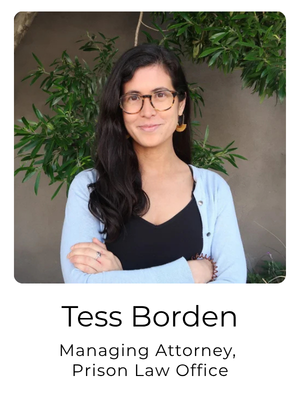
Tess Borden joined the Prison Law Office as a staff attorney in 2022. She works on issues related to disability accommodations in California state prisons and conditions of confinement in county jails. Before PLO, Tess was a staff attorney at the ACLU of New Jersey, where she litigated conditions of confinement and criminal legal system reform in federal and state courts and testified before the legislature on solitary confinement, prison oversight, and officer-perpetrated abuse. She was appointed by Governor Phil Murphy to serve on the Advisory Board to the New Jersey Office of Corrections Ombudsperson, an independent oversight entity, and on the Inter-Agency Working Group on Body Worn Cameras. Tess has also worked for the ACLU National Office, Human Rights Watch in New York and Dakar, Senegal, and the International Criminal Tribunal for the former Yugoslavia in The Hague, Netherlands, as well as spending time before law school as an immigration paralegal. Throughout law school, she served as researcher to the late Christof Heyns, United Nations Special Rapporteur on extrajudicial, summary or arbitrary executions. Tess received her J.D. cum laude from Harvard Law School in 2014 and her B.A. from Yale College and clerked for the Honorable George A. O’Toole, Jr. of the U.S. District Court for the District of Massachusetts. She is admitted to the New York Bar and is registered by the State Bar of California as a Registered Legal Aid Attorney.
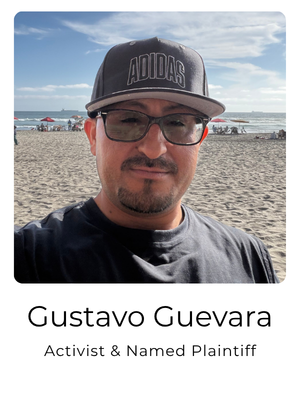
- Gustavo Guevara grew up in Southern California and considers himself a Californian and American. He is a longtime activist and organizer, first in the California state prison system and then in ICE detention. He was incarcerated as a so-called “youth offender” and spent two decades in the California Department of Corrections and Rehabilitation (CDCR), where he participated in hundreds of hours of self-help groups, obtained certifications in masonry, welding, and janitorial programing, led a youth diversion program, held various prison jobs, and made charitable donations of what funds he had. He was granted parole the first time he appeared before the Board.
In ICE custody, his organizing began at Golden State Annex (GSA), first as a solo advocate and then as an inside organizer in coordination with the California Collaborative for Immigrant Justice and other immigrant justice groups. He was on the first bus from GSA to California City Detention Facility when it opened in August 2025 and organized detained people there to challenge their conditions through collective action and litigation. Gus is a current named plaintiff in Gomez Ruiz et al. v. ICE et al., which challenges inadequate medical care, punitive conditions of confinement, restrictions on attorney access, and failures in disability accommodations at California City. In this role, he helped the legal team secure a preliminary injunction and appointment of an external monitor, the first-ever court-appointed monitor to review the full-scope of medical care at an ICE facility. His legal team often jokes he is their lead investigator: he has helped sign up other plaintiffs, obtain dozens of declarations from detained people, and refer numerous patients to the external monitor, in addition to keeping the legal team apprised of fact developments and brainstorming case strategy. He remains actively involved in the litigation even after his deportation and is committed to continuing his advocacy for people in prison and ICE detention.
Gus enjoys reading, exercising, making art, and connecting with community. He has an active spirituality practice, which he credits for helping him through especially difficult times. He continues to fight in his immigration case, with the goal of being allowed to return to the United States.
Alexa Van Brunt is the Director of the Illinois office at the MacArthur Justice Center (MJC). She also directs and teaches the Civil Rights Litigation Clinic at Northwestern Pritzker School of Law. Alongside her colleagues at MJC, Alexa litigates complex civil cases challenging mass imprisonment and promoting criminal legal system reform. She has served as lead counsel on class action suits challenging discriminatory and excessive force by law enforcement and federal immigration agents, the violation of immigrant and prisoners’ rights in correctional facilities, denial of access to counsel for people in custody, wrongful conviction damages actions, and the overuse of pretrial detention in the criminal courts. She also supervises teams of law students who serve as junior counsel on MJC’s cases.
Alexa is the recipient of the Ruth Goldman Award from the Chicago Chapter of the American Constitution Society, the Award for Excellence in Pro Bono Service from the U.S. District Court for the Northern District of Illinois, and the Illinois Voters of Illinois Independent Precinct Organization’s “Legal Eagle” award.
Prior to joining MJC, Alexa clerked for the Hon. Myron Thompson, U.S. District Court – Middle District of Alabama. Alexa received a law degree, with distinction
Kyle Virgien is a Senior Staff Attorney at the ACLU National Prison Project. He focuses on challenging unconstitutional conditions in ICE detention facilities and fighting the expansion of detention. In addition, he has previously worked in impact litigation and advocacy on topics including the COVID-19 crisis behind bars, electronic surveillance by the government, and disability rights.
CLE Materials
Alina Das, The Law and Lawlessness of U.S. Immigration Detention, 138 Harv. L. Rev. 1186 (2025)
- Gonzalez v. Noem, No. 1:25-cv-13323 (N.D. Ill.)
- Complaint (Oct. 30, 2025)
- Proposed Memorandum in Support of Class Cert. (Oct. 30, 2025)
- Temporary Restraining Order (Nov. 5, 2025)
- Order Granting Motion for Class Cert. (Nov. 17, 2025)
Damages
This panel will address achieving accountability for misconduct behind bars through cases for compensatory and punitive damages. It will explore the doctrinal and practical challenges in prosecuting cases for damages, as well as the opportunities that these lawsuits present for effecting change, deterrence, and public attention to what is happening inside detention facilities across the country.

Panelist Biographies
- Sarah Grady is a Co-Founder and Partner at Kaplan & Grady. Sarah has represented thousands of currently and formerly incarcerated individuals, and their families, at trial and on appeal. She focuses on claims involving violations of the Constitution and federal law, including those involving death, denials of medical and mental health care, excessive force, and sexual assault against government officials and companies charged with safeguarding loved ones behind bars. She has recovered tens of millions of dollars on behalf of her clients, including record settlements and trial wins. Before co-founding Kaplan & Grady, Sarah established and led Loevy & Loevy’s Prisoners’ Rights Project. [continued at link above…]
- Jaehyun Oh is a partner of a NYC-based litigation boutique, Jacob Fuchsberg Law Firm, and leads the Firm’s civil rights department. As of 2022, Jae secured then-largest settlement in history for sexual assault of incarcerated persons in Federal Bureau of Prisons custody. Since then, Jae has represented numerous survivors of sexual abuse, in and out of carceral setting. Of note, she has represented 36 women who were sexually abused in FCI Dublin. She served as plaintiffs’ liaison-counsel in over a hundred civil cases that have been filed in relation to FCI Dublin sexual abuse, which was resolved in the excess of $100 million. She has also represented a victim testifying before the U.S. Senate on the issue of prison sexual abuse, which was instrumental in reforms within the federal government including passage of the Prison Camera Reform Act. In addition to sexual abuse, Jae has successfully handled and continues to litigate numerous matters in the areas of prisoner rights, police brutality, medical malpractice, personal injury, and employment discrimination.
- Omar Qureshi is a record-setting civil rights trial lawyer, founder of Qureshi Law, and a Moth GrandSlam storytelling champion who has secured over $100 million in civil rights verdicts and settlements within five years of founding his firm. A graduate of Stanford Law School, his landmark trial results include a record-breaking $42.75 million federal jury verdict for the family of Erie Moore, Sr.—the largest ever against a private correctional company in U.S. history—and a $45 million civil rights verdict on behalf of two students with autism abused because of their disabilities. Also an accomplished comedian and storyteller whose work has been featured on NPR and at the Sundance Film Festival, Omar combines compelling trial techniques, visual presentation, and human storytelling to achieve historic verdicts.
Andrea Woods is a partner with Budge & Heipt, a boutique Seattle-based law firm focused on accountability when people suffer behind bars or at the hands of law enforcement.
Andrea clerked for Federal District Court Judge John Coughenour of the U.S. District Court for the Western District of Washington. Following her federal clerkship, Andrea spent seven years as a staff attorney with the national office of the American Civil Liberties Union, where she focused on litigation involving criminal justice reform. At the ACLU, Andrea sued jail officials across the country for their unconstitutional practices. She filed numerous complex civil rights lawsuits as lead counsel, authored reports, trained other attorneys, and spoke to the media and served on dozens of panels. She is nationally recognized for her work, which has been featured in the New Yorker, the Guardian, the Appeal, CNBC, the Atlanta Journal-Constitution, the Memphis Flyer, the Dallas Morning News, and numerous other news outlets.
CLE Materials
- Clayton T. Johnson v. Peter Wachtel et al., No. 1:20-cv-05913 (S.D.N.Y.)
- Complaint (July 30, 2020)
- Order Denying Motion to Dismiss (Aug. 16, 2021)
- Karilie Herrera et al. v. United States et al., No. 1:20-cv-10206 (S.D.N.Y.)
- J.K.J. v. Polk County, 960 F.3d 367 (7th Cir. 2020) [Opinion]
Jorge Villalobos et al. v. Captain Smith et al., No. 1:20-cv-09736 (S.D.N.Y.)
- Amended Complaint (Aug. 25, 2021)
- Order Granting/Denying Motion to Dismiss in Part (May 16, 2022)
- William Dean v. Wexford Health Sources, 18 F.4th 214 (7th Cir. 2021) [Opinion]
- Lisa Johnson-Barker v. Wexford Health Sources, No. 1:20-cv-05913 (C.D. Ill.)
- Plaintiff’s Opp. to Motion for Partial Summary Judgment (Mar. 17, 2026)
- Order Granting/Denying Summary Judgment in Part (July 1, 2026)
Glenn Thrush, When Prison and Mental Illness Amount to a Death Sentence, N.Y. Times (May 7, 2024)
Doctrinal Developments: Risks & Opportunities
A discussion of doctrinal developments in federal court, and opportunities in state court. Bonus: a demonstration of online resources that may help your litigation, focusing on AI access to Court Listener, and the Civil Rights Litigation Clearinghouse.
Panelist Biography
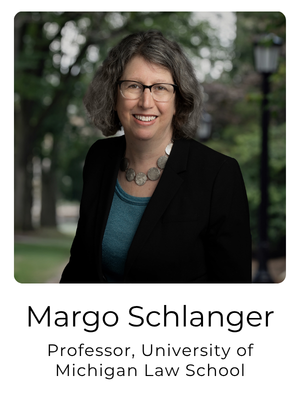
Margo Schlanger is an authority on civil rights issues and civil and criminal detention. She joined the University of Michigan Law School faculty in fall 2009. She teaches about constitutional law, torts, and civil rights, including classes related to jails and prisons. She also founded and runs the Civil Rights Litigation Clearinghouse. Previously, she was a professor at Washington University in St. Louis and an assistant professor at Harvard University.
Schlanger is the author of dozens of law review and other scholarly articles and is a frequent commentator online and in print on civil rights topics. She is the lead author of a leading casebook, Incarceration and the Law (West Academic Publishing, 2020). In 2025-2026, she will be Phi Beta Kappa Visiting Scholar.
In addition to her research and writing, Schlanger does substantial work in civil rights litigation and prison and immigration reform. She was class counsel in Hamama v. Adducci, a national class action to ensure due process for Iraqi nationals whom the Trump administration sought to deport. She was the court-appointed monitor for a statewide settlement dealing with deaf prisoners in Kentucky. And she has served as an expert in numerous cases addressing detention conditions.
Schlanger took a two-year leave from the University of Michigan in 2010 and 2011 to serve as the presidentially appointed officer for civil rights and civil liberties at the US Department of Homeland Security (DHS). As the head of civil rights and civil liberties, she was the secretary’s lead adviser on civil rights and civil liberties issues. Later in the Obama administration, she assisted in the development of DHS policies relating to reducing sexual abuse and the use of solitary confinement in immigration detention. She also served on the DHS’s Advisory Committee on Family Residential Centers, which recommended abolishing family detention.
From 1995 to 1998, she was a trial attorney in the US Department of Justice Civil Rights Division, where she worked to remedy civil rights abuses by prison and police departments and earned two Division Special Achievement awards.
Schlanger served on the Vera Institute’s blue ribbon Commission on Safety and Abuse in America’s Prisons, worked as an adviser on the development of proposed national standards implementing the Prison Rape Elimination Act, and testified before the Prison Rape Elimination Commission. She also served as the reporter for the American Bar Association’s revision of its Standards on the Treatment of Prisoners and as chair of the Association of American Law Schools Section on Law and the Social Sciences.
CLE Materials
- Lippert v. Hughes, 171 F.4th 992 (7th Cir. 2026). Decided Apr. 2, 2026.
- Parker v. Hooper, 171 F.4th 736 (5th Cir. 2026) (en banc). Filed Mar. 30, 2026.
- Poynter ex rel. Fernandez v. Shirley, No. 25-5188, 2026 WL 2641092 (6th Cir. Sept. 8, 2026) (en banc). Not yet in F.4th.
- Spivey v. Breckon, 173 F.4th 174 (4th Cir. 2026). Decided Apr. 20, 2026.
- Taylor v. Trump, 823 F. Supp. 3d 17 (D.D.C. 2026). Signed Feb. 11, 2026.
- Voice of the Experienced v. LeBlanc, No. 23-cv-01304, 2026 WL 1472248 (M.D. La. May 26, 2026).
Early-Career Attorney Investigation Training
The Early-Career Attorney training will present on the investigative process for a case addressing potential constitutional violations in a carceral setting, from initiation to drafting a complaint. Using an ongoing investigation into the Mississippi Department of Corrections as a case study, Emma and Andrea will talk about practical lessons, early successes and pitfalls, and the essential elements of an investigation. Attendees will then be asked to put together their own investigation plan based on a provided closed-universe hypothetical. The attendees’ work will be evaluated by experienced attorneys, giving each attendee an opportunity to learn from a litigator who has completed successful investigations.
Panelist Biographies
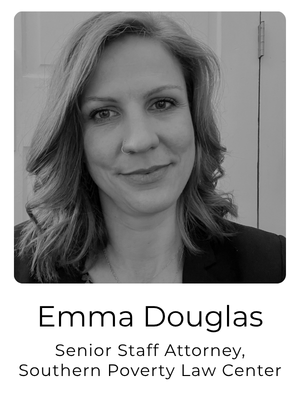
Emma Douglas is a Senior Staff Attorney in the Criminal Legal Systems Reform program group at the Southern Poverty Law Center. She has been practicing law since 2017 when she graduated from Loyola University New Orleans, College of Law. Emma also holds a Masters’s Degree in Public Administration, concentrating in Gender Based Violence, and a bachelor’s degree in Women’s Studies and Political Science.
Emma has spent her career building case management programs rooted in serving the community. She has worked with people experiencing homelessness, children who have recently experienced homelessness, survivors of human trafficking, and the working poor. She came to law school after a 10-year career in non-profits and immediately began focusing her scholarship and experiential learning on the prison industrial complex and the effects of incarceration on those who have survived the experience. She continues that work at SPLC. Before working for SPLC Emma held staff attorney positions at Indiana Legal Services and Disability Rights Louisiana.
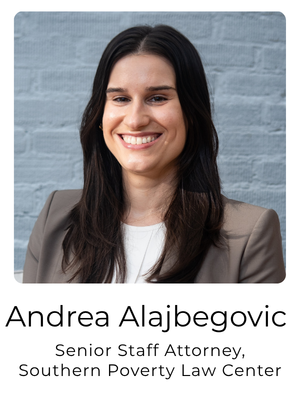
Andrea Alajbegovic is a Senior Staff Attorney on the Criminal Legal System Reform litigation team at the Southern Poverty Law Center (SPLC) in Jackson, Mississippi, where she works to hold law enforcement and correctional institutions accountable for systemic abuses in some of the nation’s most challenging legal landscapes. Prior to her work at SPLC, Andrea represented tenants in eviction proceedings at Brooklyn Legal Services and taught at an elementary school in Brooklyn. She holds a J.D. from CUNY School of Law, an M.S.Ed. in Special Education and Teaching from Brooklyn College, and a B.A. in International Studies and Political Science from the University of Michigan. A first-generation American and the daughter of immigrants from the former Yugoslavia, Andrea grew up in Ann Arbor, Michigan, and spent nearly a decade in New York City. She now lives in Jackson with her husband and young daughter.
- Nishi Kumar is the Director of Medical Legal Projects at the Medical Justice Alliance, a non-profit organization of volunteer medical professionals that protects the right to medical care for every person incarcerated. Nishi is an experienced civil rights attorney and was most recently the Director of Civil Litigation at the Promise of Justice Initiative in New Orleans, Louisiana. There, she advocated on behalf of and alongside currently and formerly incarcerated people throughout Louisiana, specifically at the intersection of mass incarceration and healthcare. She was previously an adjunct professor at Loyola Law School, where she co-taught an incarceration seminar. Nishi graduated from NYU Law School, where she was a Hays Civil Liberty fellow, a Notes Editor on the NYU Law Review, and co-chair of the South Asian Law Students Association. After law school, she clerked for Judge Paul Watford on the Ninth Circuit and Judge Jesse Furman on the Southern District of New York.
CLE Materials
- PROCEDURAL MEANS OF ENFORCEMENT UNDER 42 U.S.C. § 1983, 37 Geo. L.J. Ann. Rev. Crim. Proc. 990
- SECTION 1983 LITIGATION IN A NUTSHELL: MAKE A CASE OUT OF IT!, 17 DCBA Brief 14
Effecting Real Change Post Consent Decree
In many injunction cases, winning a judgment or entering into a consent decree turns out to be easier than actually obtaining relief. The panel will address some of the difficulties attorneys face enforcing orders/decrees, creative arguments defendants have begun to advance to avoid compliance, and (hopefully) some creative solutions.
Panelist Biographies
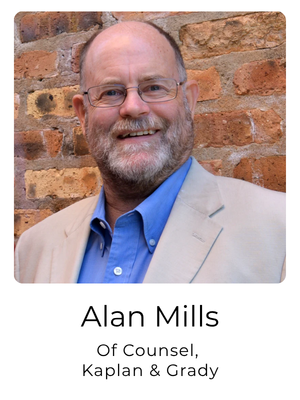
Alan Mills is a nationally recognized prisoner rights advocate who has devoted decades to representing incarcerated individuals. Prior to joining Kaplan & Grady, Alan was the Executive Director of the Uptown People’s Law Center (UPLC), having previously served as its Legal Director and a staff attorney. During his tenure, Alan developed the organization’s prisoner rights practice into the largest docket of prisoner civil rights cases in Illinois. His groundbreaking work has included challenges to the federal Prison Litigation Reform Act and individual cases involving excessive force, censorship, religious diet refusals, and due process violations [continued at link above…]
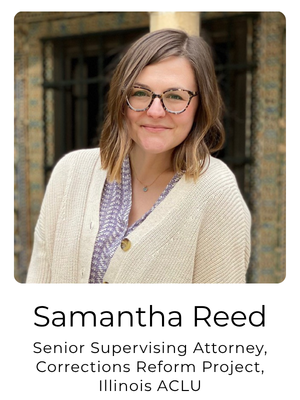
Samantha Reed is a Senior Supervising Attorney in the Corrections Reform Project at the Illinois affiliate of the American Civil Liberties Union. She has over a decade of experience with prison litigation and consent decree enforcement in the federal courts. She serves as class counsel in Lippert v. Hughes (seeking reforms in medical care in Illinois prisons); Monroe v. Hughes (seeking improved care for Illinois prisoners with gender dysphoria); and R.J. v. Vickery (seeking improvements in education for youth confined in Illinois’ Department of Juvenile Justice). Previously, she worked on the Rasho v. Baldwin class action seeking improvements in mental health care in Illinois prisons, cases challenging the use of solitary confinement in juvenile detention settings, and other individual lawsuits and advocacy on behalf of prisoners with disabilities. Ms. Reed has also taught Prisoner Constitutional Rights Litigation at Loyola University Chicago School of Law. She holds a J.D. from University of California, Berkeley Law, and a B.S. in Social Policy from Northwestern University.
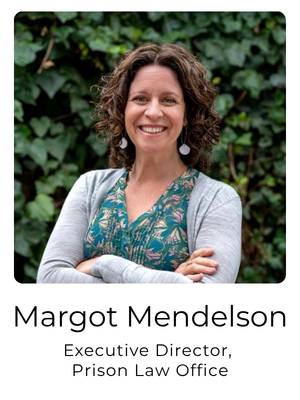
Margot Mendelson joined the Prison Law Office as a staff attorney in 2016 and has served as Executive Director since 2023. She previously served as Legal Director. Her work focuses on improving conditions of confinement and protecting the rights of people who are incarcerated or detained. She has extensive experience in class action litigation and in negotiating, implementing, and enforcing consent decrees and other forms of institutional reform. She has worked on a broad range of issues related to carceral confinement, including access to health care, disability rights, use of force, staff misconduct, and conditions in prisons, jails, and immigration detention centers.
A central focus of Margot’s work has been ending the use of solitary confinement through litigation, legislative advocacy, and technical assistance. She has spoken on issues related to ICE detention, mental health care in carceral settings, and the use of solitary confinement. She has testified before the California State Legislature about the widespread use of solitary confinement in the state and its devastating effects on individuals, families, and communities.
Before joining the Prison Law Office, Margot was an attorney at Rosen Bien Galvan & Grunfeld, where she practiced complex civil litigation in state and federal courts at both the trial and appellate levels, with a focus on civil rights. She was also an Arthur Liman Public Interest Fellow, representing immigrants detained in Southern Arizona.
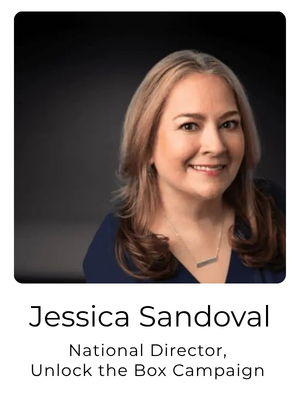
Jessica Sandoval, MPA, is a nationally recognized organizer and campaign strategist with more than three decades of experience advancing justice for people impacted by incarceration. She serves as the National Director of the Unlock the Box Campaign, leading a nationwide movement to end solitary confinement in U.S. prisons and jails, youth facilities and immigrant detention. Previously, as Vice President and Deputy Director of the Campaign for Youth Justice, she helped secure reforms in 40 states and jurisdictions that contributed to an 85% reduction in the prosecution of youth as adults. Her work has been featured by NPR, PBS, Rolling Stone, Esquire, and Business Insider.
CLE Materials
- A Blueprint for Ending Solitary Confinement by the Federal Government, ACLU and the Federal Anti-Solitary Taskforce (FAST) (2021)
- Lauren Brinkley-Rubinstein et al., Association of Restrictive Housing During Incarceration With Mortality After Release, 322 JAMA 1202 (2019)
- David Cloud et al., “We just needed to open the door”: a case study of the quest to end solitary confinement in North Dakota, 9 Health Justice 28 (2021)
- Craig Haney, Restricting the Use of Solitary Confinement, 1 Ann. Rev. Criminol. 285 (2018)
- Bryant J. Jackson-Green, Healthcare Reform via Judicial Oversight: Navigating Obstacles and Enablers in the Implementation of Consent Decrees within Adversarial Systems, Health Change (2026)
- Corene Kendrick, Winning a Case is Not the End: Making the Right to Prison Health Care a Reality, 19 U. St. Thomas L.J. 474 (2023)
- Morgan S. Mason, Breaking the Binary: How Shifts in Eighth Amendment Jurisprudence Can Help Ensure Safe Housing and Proper Medical Care for Inmates with Gender Dysphoria, 71 Vand. L. Rev. En Banc 157 (2018)
- Katie Rose Quandt, Proponents of Solitary Confinement Attempt to Stifle Reform, The American Prospect (2026)
- Solitary is Never the Answer [Report], Unlock the Box (June 2020)
Extreme Heat & Incarceration
Extreme heat, exacerbated by global warming, increasingly exposes incarcerated people to life-threatening risk. In this session, we will hear from lawyers and other advocates who are working to protect incarcerated people as temperatures rise.


Panelist Biographies
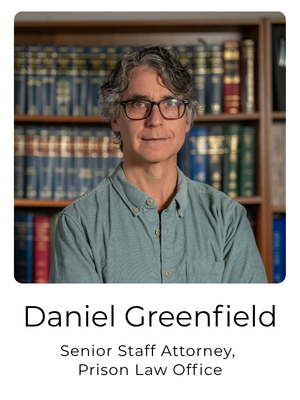
- Daniel Greenfield is a Senior Staff Attorney at the Prison Law Office (PLO). Daniel joined PLO in 2024 as a Senior Staff Attorney. Prior to joining PLO, Daniel was Supreme Court and Appellate Counsel at the MacArthur Justice Center, where he litigated jail and prison conditions cases, with a focus on solitary confinement and other inhumane practices. Daniel previously taught at both UCLA School of Law, where he was co-director of the Prisoners’ Rights Clinic, and Northwestern University School of Law, where he co-taught the MacArthur Justice Center’s appellate litigation clinic. Before joining the MacArthur Justice Center, Daniel was pro bono counsel at Sidley Austin, completed a fellowship at the Center on Wrongful Convictions, and served as a law clerk to the Honorable Diane E. Murphy of the U.S. Court of Appeals for the Eighth Circuit. He received a J.D. from Northwestern in 2008. He also holds an M.F.A. from New York University’s Tisch School of the Arts and a B.S. from Northwestern. Daniel is admitted to the bars of Washington, D.C. and Illinois and is registered by the State Bar of California as a Registered Legal Aid Attorney.
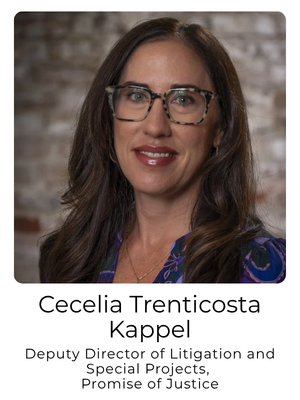
Cecelia Trenticosta Kappel is the Deputy Director of Litigation and Special Projects, where she leads complex litigation and strategic advocacy efforts focused on ending mass incarceration, protecting the rights of people in prison, and confronting racial and structural inequities in the legal system. Previously, she served as Director of the Loyola Center for Social Justice, and as Executive Director of the Capital Appeals Project, a state-funded nonprofit dedicated to ensuring high-quality legal representation for individuals on Louisiana’s Death Row. A native New Orleanian, Cecelia attended Benjamin Franklin High School, the New Orleans Center for Creative Arts, Tulane University, and Loyola University New Orleans College of Law.
- Erica Grossman is a partner in the law firm of Holland, Holland Edwards & Grossman. Erica was listed as the 2024 Lawyer of the Year for Civil Rights Law in Denver by Best Lawyers, and listed by Best Lawyers since 2019. Erica has been named a Colorado Super in Lawyer since 2016, in 5280’s Top Lawyers in Civil Rights Litigation, and also been selected as one of National Trial Lawyers’ Top “40 under 40” lawyers.
Erica has litigated a number of cases involving police brutality, unconstitutional jail conditions, first amendment issues, discrimination, and retaliation. She and her firm represented several prisoners held at Guantanamo Bay, recently obtaining the release and repatriation of a Mauritanian man captured unlawfully in 2002. Erica also represents families in nursing home and assisted living litigation.
In December 2014, Erica, along with Anna, received an over $11,000,000 jury verdict on behalf of Ken McGill, an inmate at Jefferson County Jail, who suffered a stroke and was cruelly denied timely medical care. This case was a finalist for the Colorado Trial Lawyers Association case of the year in 2015.
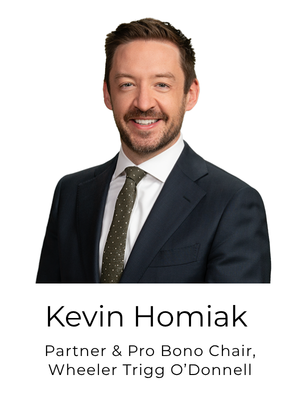
Kevin Homiak defends sophisticated clients nationwide in professional liability and catastrophic injury cases. He has won multiple jury verdicts as lead trial counsel and, through aggressive motions practice, has won the complete dismissal of high-exposure claims against his clients. Kevin also is the Chair of Wheeler Trigg O’Donnell’s Pro Bono Committee. His victories for pro bono clients include some of the largest awards in Colorado history, and his pro bono work has been featured in The New York Times, Law360, NPR’s “All Things Considered,” USA Today, and other national news outlets.
In addition to his trial practice, Kevin also handles high-stakes appeals. His appellate experience spans multiple state and federal appellate courts, and he currently serves as appellate monitoring counsel for one of the world’s largest companies in several high-exposure cases across the country. In that capacity, he recently won case-ending summary judgment in a case in which the plaintiff sought over $130 million in damages.
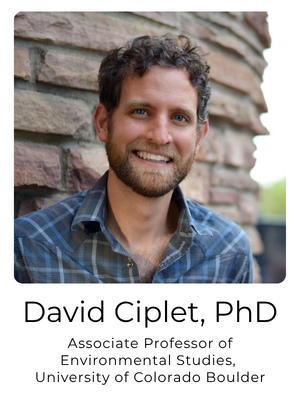
- David Ciplet is a sociologist focused on understanding how relationships of power and inequality in environmental governance shape efforts for a more socially just society. Ciplet is a founding member and Director of the Climate and Incarceration Research Collective at the University of Colorado Boulder. He previously founded and co-directed the CU Boulder Just Transition Collaborative, which worked to ensure that transitions to sustainable energy are rooted in the leadership and needs of those most directly impacted by forms of social and environmental inequality. He works with his students and KGNU radio station to produce the series the Brink: Stories of Inequality, Struggle and Transformation.
Karín Umfrey is a senior staff attorney at Worksafe Inc. Karín attended University of Pittsburgh School of Law where she founded the Latin American Law Students Association, reviving and rebuilding a prior organization. As President, she organized panels to engage the community by collaborating with student groups and attorneys from the Pittsburgh Area.Karín has assisted Spanish-speakers in the Baltimore community access healthcare resources. Her interest in occupational health began when she was introduced to a Latino and immigration advocacy-and-assistance organization where she learned about quality of life issues facing workers. She is interested in evaluating the intersection between work and the social determinants of health.
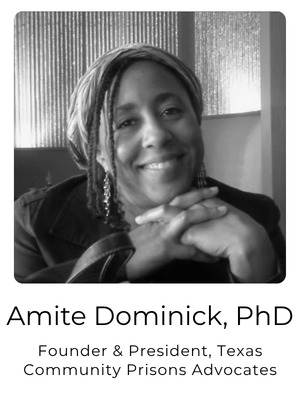
Amite Dominick founded Texas Prisons Community Advocates. Dr. Dominick is a system-impacted woman of color whose advocacy is rooted in both professional expertise and lived experience. While her prison advocacy began in 2015 during her then-husband’s incarceration, her connection to the criminal legal system extends across her lifetime as an impacted family member.
Since entering the advocacy space, Dr. Dominick has become one of Texas’ leading voices for humane prison conditions. She has worked alongside legislators to file every historic bill seeking humane temperature standards in Texas prisons, provaided expert testimony before the Texas Legislature, co-authored research reports, trained impacted family members in advocacy, and organized statewide awareness campaigns. Her work has been featured across news media, publications, conferences, and public forums.
Before founding TPCA, Dr. Dominick served as a founding board member and Vice President of the Texas Prisons Air Conditioning Advocates (TPAA) from 2018–2021 and previously served on the board of Texas CURE.
Dr. Dominick holds a Bachelor’s degree in Clinical and Counseling Psychology and a Master’s degree in Psychology from San José State University, as well as a Doctorate in Psychology from Loma Linda University. Her academic work focused on experimental, biological, and social psychology.
CLE Materials
- Tiede v. Collier, No. 1:23-CV-1004 (W.D. Tex)
- First Amended Complaint (May 7, 2024)
- Order Denying Preliminary Injunction (Mar. 26, 2025)
- Order: Findings of Fact (Sept. 22, 2026)
- VOTE v. LeBlanc, No. 3:23-CV-01304 (M.D. La)
- Complaint (Sept. 16, 2023)
- Order (June 23, 2026)
- Motion for Reconsideration (May 26, 2026)
- Mass Incarceration as a Climate Justice Issue
- Proposed new section 3397—Heat Illness Prevention in Indoor Correctional and Detention Facilities
- Final Written Comment: Indoor Heat in Carceral Settings
- Comments: So Cal Coalition for Safety and Health
- Provisions of Air Condition and Heat-Related Mortality in Texas Prisons
Financial Exploitation of Incarcerated People
This session will explore various ways in which incarcerated people are financially exploited by the state, as well as strategies to protect clients. Discussants will share their current work challenging forced labor, pay-to-stay laws, and telecoms/commissary exploitation and protecting client’s money judgments or assets from state seizure.

Panelist Biographies
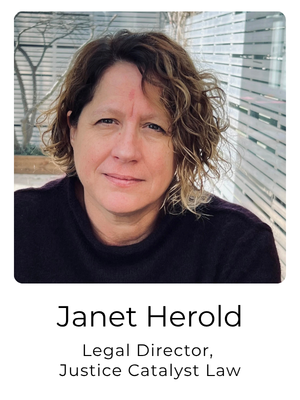
- Janet Herold is the Legal Director of Justice Catalyst Law, where she leads cross-cutting innovative class action, consumer, and antitrust litigation spanning multiple legal areas of specialities.
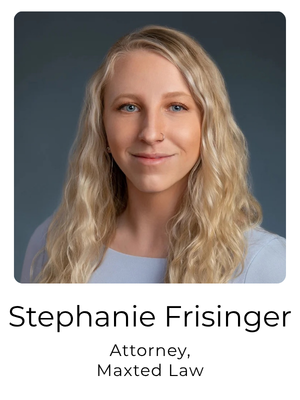
- Stephanie Frisinger is a civil rights and criminal lawyer with a special interest in impact litigation that results in systemic change to the American carceral system, including
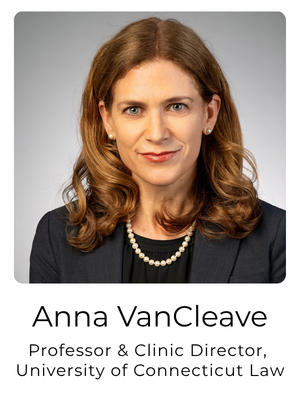
class actions and strategic litigation. She is the co-founder of the social justice firm Summit Justice Law Firm and is based in Colorado. Anna VanCleave is a former public defender in capital and non-capital cases and a law professor at University of Connecticut, where she directs the criminal defense clinic.
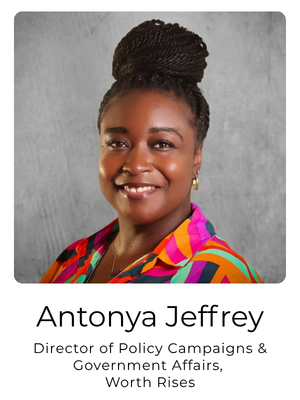
Antonya Jeffrey is the director of policy campaigns and government affairs at Worth Rises.
Krista Dolan is a Senior Supervising Attorney with the Southern Poverty Law Center’s Criminal Legal System Reform team. She has litigated cases addressing prison and jail conditions, medical neglect behind bars, police misconduct, government transparency in corrections, and the financial exploitation of incarcerated people. Before joining SPLC, Krista served as the chief advisor for justice issues in the Florida House Democratic Office, following nearly a decade litigating postconviction cases in Kentucky and Florida, where she led or co-counseled cases resulting in ten exonerations. Krista holds a J.D. from Florida State University and an LL.M. in Law & Government from American University. Outside of work, she enjoys spending time with her family, reading, and traveling.
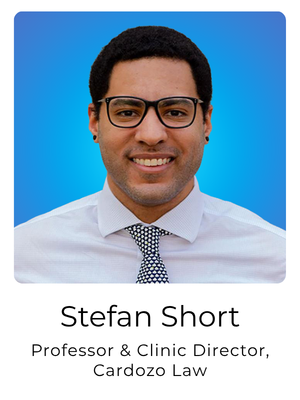
Stefen R. Short is an Assistant Professor of Law at Benjamin N. Cardozo School of Law where he co-directs the Civil Rights Clinic. He joined Cardozo from the National Center for Law and Economic Justice, where he was Special Counsel, and previously held leadership roles at Worth Rises and the Prisoners’ Rights Project of The Legal Aid Society.
CLE Materials
- Mortis v. Polis et al., No. 2022-CV-30421 (Colo. Dist. Ct. 2026)
- Plaintiffs’ Proposed Findings of Fact & Conclusions of Law (Nov. 11, 2025)
- Order on Trial – Findings of Fact and Conclusions of Law (Feb. 13, 2026)
- Justice Catalyst Law, The Alabama Solution is Modern-Day Slavery
- Council et al. v. Ivey et al., No. 2:26-cv-00574-CLM-JTA (M.D. Al. 2025)
- Moore et al. v. Ivey et al., No. 2:23-cv-712-CLM (M.D. Al. 2023)
- Baez v. Dixon, No. 4:25-cv-00216-MW-MAF (N.D. Fla. 2025)
- Amended Complaint for Declaratory and Injunctive Relief (June 16, 2025)
- Order Granting Plaintiff’s Motion for Summary Judgment (July 30, 2026)
- Initial Brief for Appellant [Baez v. Comerford, 2026 WL 2625736 (Aug. 24, 2026)]
- Anna VanCleave, Prison Banking, 112 Cal. L. Rev. 1699 (2025)
- The Prison Industry
- Chapter 7 – Telecom
- Chapter 9 – Food and Commissary
The Federal Tort Claims Act — Training
This training session will help participants learn to assess and effectively pursue damages claims against the United States under the Federal Tort Claims Act (FTCA). The focus will be on claims for clients subjected to abuse and misconduct in federal custody, including the Federal Bureau of Prisons, immigration detention, the U.S. Marshals Service, etc. This session assumes basic familiarity with federal civil rights litigation on behalf of incarcerated clients.
Panelist Biographies
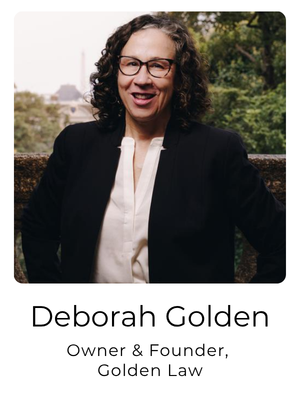
- Deborah Golden is the Founder of Golden Law. After spending 20 years working at nonprofits on behalf of incarcerated individuals and their rights, Deborah decided to form her own firm in 2019. Previously, she worked as the Director of the DC Prisoners Project of the Washington Lawyers’ Committee for Civil Rights and Urban Affairs, and as the national FOIA attorney at the Human Rights Defense Center.
In addition to her law practice, Deborah currently serves on the board of The Second Look Project. She has also served as an adjunct professor at Georgetown University Law Center and the University of Virginia.
She is a graduate of the University of Michigan Law School and Penn State University. Deb lives in NE DC with her wife and two children.
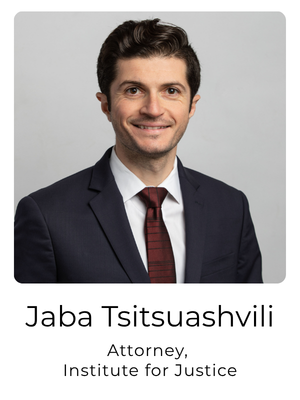
Jaba Tsitsuashvili is an attorney at the Institute for Justice. He litigates in federal courts across the country to counter abusive policing and other infringements of constitutional rights by federal and state governments.
Jaba’s cases focus on Fourth Amendment protections against unlawful searches and seizures; the due process rights of individuals accused of civil or criminal offenses; and the Eighth Amendment’s prohibition of excessive fines. Through those protections, Jaba’s work aims to scale back and eliminate abusive fines and fees, civil forfeiture of property, and accountability-eliminating doctrines like qualified immunity.
As part of IJ’s Project on Immunity and Accountability, Jaba litigates and writes amicus briefs on issues of qualified immunity, prosecutorial immunity, Bivens liability, the Federal Tort Claims Act, and related doctrines that shield police and other government actors from accountability for constitutional violations.
Before joining IJ, Jaba litigated immigrants’ due process and First Amendment rights and prisoners’ religious liberty and disability rights. For his work on behalf of detained migrants, he was a recipient of the ACLU of Southern California’s 2019 Access to Justice Award. Jaba is a graduate of the New York University School of Law and the University of California at San Diego.
- Claudia Valenzuela is a managing attorney at Immigrant Legal Defense (ILD), where she engages primarily in federal litigation, including challenges to removal orders, challenges to immigration detention, as well as efforts to secure transparency and accountability from the immigration agencies. Prior to joining ILD, Claudia was an attorney with the American Immigration Council (Council). Claudia’s work at the Council focused on transparency and accountability issues, with an emphasis on Freedom of Information Act (FOIA) advocacy and litigation. Before joining the Council, Claudia was the Detention Project Director at the National Immigrant Justice Center (NIJC), where she was engaged in representation, advocacy and impact litigation efforts primarily on behalf of individuals in Department of Homeland Security (DHS) custody. Claudia is a graduate of DePaul University College of Law
CLE Materials
- Folder of CLE materials located here.
Jailhouse Lawyering
In this session, we will focus on the work of those who litigate from inside, with panelists who have represented themselves and assisted other pro se litigants while incarcerated, then continued their advocacy after their release. What are the challenges of litigating from prison? What advantages are there? From case selection to legal research to drafting and beyond, we will look at how jailhouse lawyers and advocates outside the wall do their work, and how they might best support each other to make their work more effective.
Panelist Biographies
- Joel Thompson is the Managing Attorney at the Harvard Prison Legal Assistance Project (PLAP), a student practice organization at Harvard Law School where students represent state prisoners in prison disciplinary hearings, parole hearings, clemency petitions, and other matters, along with providing legal research support to prisoners and engaging in policy advocacy and public education about prisoners’ rights and conditions of confinement. Before returning to PLAP, where he had been a student member in the 1990s, Mr. Thompson was a staff attorney for fourteen years at Prisoners’ Legal Services of Massachusetts (PLS), a statewide legal aid office that counsels, advocates for, and brings civil rights litigation on behalf of prisoners. Mr. Thompson coordinated the office’s health care advocacy, policy, and litigation efforts, and assisted pro se prisoners and attorneys who represented prisoners in health care litigation.
Before coming to PLS, Mr. Thompson served as a law clerk in federal district court in Burlington, Vermont, and worked at law firms in Portland, Maine and Bridgeport, Connecticut.
Jonas X. Caballero is a Staff Attorney at the Pennsylvania Institutional Law Project. His work focuses on prisoners’ rights and challenging state violence and systemic injustice. While incarcerated in New York, Jonas successfully litigated in state and federal court as a pro se plaintiff, including conducting an in-person trial in the New York State Court of Claims that led to a precedential decision on privacy rights violations of incarcerated individuals during medical sedation. He is currently the lead plaintiff in a certified class action challenging mental health discrimination by the New York State Department of Corrections.
Prior to PILP, Jonas worked as a paralegal at the Abolitionist Law Center. He currently serves on the Board of Directors and the Survivor Council of Just Detention International, advancing the movement to end sexual abuse behind bars. A former U.S.–U.K. Fulbright Scholar, he earned an M.Phil. in Middle Eastern Studies from the University of Cambridge. He graduated magna cum laude from Albany Law School with a concentration in social justice, and graduated summa cum laude from the University of Pittsburgh with a B.Phil. in International Studies and Professional Communications.
- Mac Hudson is the Community Liaison and Racial Equity in Corrections Initiative (REICI) Paralegal at the Prisoners’ Legal Services of Massachusetts.
Dr. David Z. Simpson, h.c., is a nationally respected justice advocate and strategist who turned the trauma of wrongful incarceration into a life of purpose, service, and impact. After enduring 11 years in federal prison, facing solitary confinement and targeted retaliation for refusing to cooperate with ICE, David emerged not embittered, but deeply committed to protecting others from the injustices he experienced.
Under the mentorship of renowned jailhouse lawyer Garry Okpala, David became a highly skilled legal strategist while incarcerated, assisting in numerous criminal appeals and mastering the Federal Bureau of Prisons’ Administrative Remedy Process. His effectiveness and precision made him a lifeline to many behind bars seeking accountability and relief.
Following his release in 2019, David reunited with his sons and re-entered the workforce as a highly capable electrician. He was soon selected as a Justice-in-Education Scholar at Columbia University, where he met student organizer Anna Sugrue. Together, they co-founded The Remedy Project (TRP) a national nonprofit that trains students, empowers incarcerated individuals, and mobilizes communities to fight injustice through inside-outside collaboration and the remedy process [continued at link above…]
CLE Materials
- Caballero v. State of New York (N.D.N.Y.)
- Claim Filed (June 19, 2019)
- Liability Decision (Mar. 3, 2022)
- Decision (Feb. 13, 2025)
- David Z. Simpson, Understanding Justice: An Ecosystem in Crisis
Reports from the Field
Short presentations by anyone who signs up discussing an aspect of their work which might be of interest to attendees, but is not covered in a formal panel. One of the purposes of this panel is to expose conference attendees to the work being done by their colleagues, thus fostering the sorts of peer networks which research has found are a key to combating secondary trauma.
Panelist Biographies
Alan Mills is a nationally recognized prisoner rights advocate who has devoted decades to representing incarcerated individuals. Prior to joining Kaplan & Grady, Alan was the Executive Director of the Uptown People’s Law Center (UPLC), having previously served as its Legal Director and a staff attorney. During his tenure, Alan developed the organization’s prisoner rights practice into the largest docket of prisoner civil rights cases in Illinois. His groundbreaking work has included challenges to the federal Prison Litigation Reform Act and individual cases involving excessive force, censorship, religious diet refusals, and due process violations [continued at link above…]
CLE Materials
- Ray Nickson et al., Why Peer Support Matters for Healthy Lawyers, Law Society Journal Online (2026)
- Kate Whittenbury et al., Strengths for Helping Professionals Exposed to Secondary Trauma: A Scoping Review, 26 Sage J. 2 (2025)
Sleep Deprivation in Carceral Spaces: Research, Personal Experience, Litigation Strategies
Chronic sleep deprivation appears to be a constitutive feature of life in custody. Yet sleep is a basic human need, and not getting enough takes a serious toll: persistent inadequate sleep brings increased risk of serious medical conditions, exacerbates all major psychiatric conditions, and compromises cognitive functioning and emotional resilience. This panel will explore this issue for the carceral context. Panelists will share research findings suggesting the endemic nature of sleep deprivation in carceral spaces, describe what it is like to try to sleep inside and the toll of persistent sleep deprivation on those who endure this experience for years and even decades, and begin the process of strategizing possible litigation to challenge the conditions that make it impossible for people in prison and jail to get sufficient sleep.
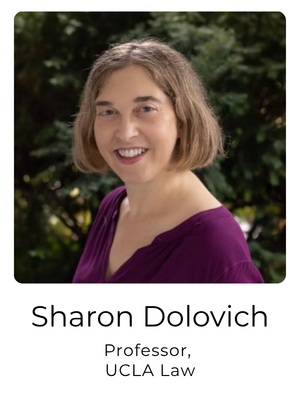
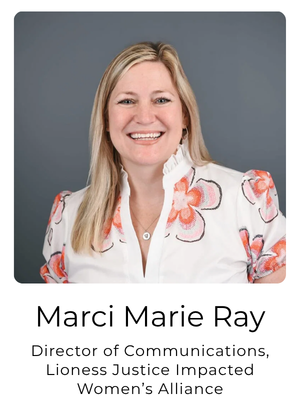

Panelist Biographies
- Sharon Dolovich is a leading scholar of prisons and prison law. Her work focuses primarily on the Eighth Amendment, prison conditions, and the state’s obligations to the incarcerated. She directs the UCLA Prison Law & Policy Program and the UCLA Law Behind Bars Data Project, and teaches courses on criminal law, the constitutional law of prisons, and other post-conviction topics. Dolovich is also the Faculty Co-Director of the UCLA Criminal Law and Policy Consortium. She has been a visiting professor of law at NYU, Harvard, and Georgetown, and a fellow at the Radcliffe Institute for Advanced Study and with the Program on Ethics and the Professions at Harvard’s Kennedy School of Government. In 2021, she received the UCLA Distinguished Teaching Award, the university’s highest honor for excellence in teaching [continued at link above…]
Marci Marie Ray is the Director of Communication at Lioness Justice Impacted Women’s Alliance, a nonprofit organization founded and led by currently and formerly incarcerated girls, women, and gender-expansive people. Marci works to change how people understand women’s incarceration and the harm caused by the criminal legal system. As a member of the LGBTQIA+ community, her advocacy centers the experiences of incarcerated and formerly incarcerated women and other marginalized populations, using education, storytelling, and digital organizing to push for meaningful change.
She is the co-host of On the Rec Yard: Women’s Prison Podcast, and a content creator with nearly 300,000 followers on TikTok, where she uses direct, accessible storytelling to reach broad audiences and move people toward action. Her work is informed by her experience surviving ten years in a Texas prison and remains grounded in accountability to the communities most impacted.
Michael W. Bien is co-founding partner of Rosen Bien Galvan & Grunfeld LLP where he concentrates his litigation practice on complex commercial litigation, class actions, constitutional and civil rights law, antitrust, intellectual property, disability rights, and attorneys’ fees disputes. Mr. Bien served as Managing Partner of the firm for its first 27 years.
The Daily Journal recognized Mr. Bien in 2021 as one of California’s Top Lawyers of the Decade. He was named a California Lawyer Attorney of the Year for 2010 by both California Lawyer magazine and The Recorder and has been recognized by the Daily Journal as one of the Top 100 lawyers in California 13 times – 2010, 2013, and 2015-2025. He has also been recognized by Best Lawyers in America for Commercial Litigation since 2013.
Emma Douglas is a Senior Staff Attorney in the Criminal Legal Systems Reform program group at the Southern Poverty Law Center. She has been practicing law since 2017 when she graduated from Loyola University New Orleans, College of Law. Emma also holds a Masters’s Degree in Public Administration, concentrating in Gender Based Violence, and a bachelor’s degree in Women’s Studies and Political Science.
Emma has spent her career building case management programs rooted in serving the community. She has worked with people experiencing homelessness, children who have recently experienced homelessness, survivors of human trafficking, and the working poor. She came to law school after a 10-year career in non-profits and immediately began focusing her scholarship and experiential learning on the prison industrial complex and the effects of incarceration on those who have survived the experience. She continues that work at SPLC. Before working for SPLC Emma held staff attorney positions at Indiana Legal Services and Disability Rights Louisiana.
CLE Materials
- Sharon Dolovich, Sleep Deprivation in Prison, 99 S. Cal. L. Rev. 95 (2026)
Strategies for Decarceration
This panel will focus on litigious and non-litigation decarceration efforts, including parole and post-parole efforts to prevent reincarceration, and legislative strategies to reduce incarceration. Panelists will discuss their work organizing while incarcerated, inside-outside organizing, habeas petitions as a decarceration tool, and how impact litigation can contribute to decarceration efforts.
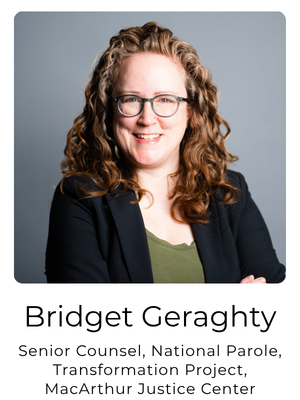
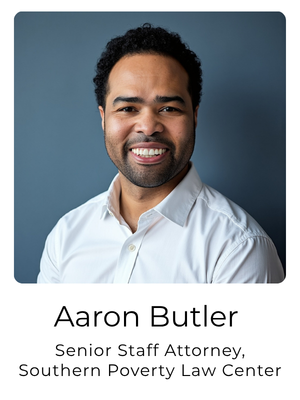
Panelist Biographies
- Bridget Geraghty is Senior Counsel leading the launch of the National Parole Transformation Project. She has represented clients throughout all stages of the criminal legal system, from arrest and arraignment, to trial and appeal, to conditions of confinement and parole.
Bridget began her legal career as a trial level public defender in Richmond, Virginia. She then joined the Office of the State Appellate Defender in Illinois, where she represented clients challenging their criminal convictions on appeal. Before coming to the MacArthur Justice Center in 2022, she was a staff attorney at the Uptown People’s Law Center representing Illinois prisoners in federal civil rights cases and parole proceedings.
Bridget received a bachelor’s degree from the University of Illinois, Urbana-Champaign and a law degree from the George Washington University Law School. Before law school, she was a high school teacher in Chicago. Caitlin Glass writes about criminal law and procedure, race and the law, participatory methods, and movement law. Among other things, her recent work explores legal, theoretical, and moral critiques of imputed liability doctrines such as felony murder and accomplice liability. Her scholarship has been published or is forthcoming in the Minnesota Law Review, the Northwestern University Law Review and the Fordham Urban Law Journal. She is a Non-Resident Fellow at the Fred T. Korematsu Center for Law and Equality.
At BU Law, Professor Glass directs the Racial Justice and Movement Lawyering Clinic, which provides legal support to organizations, coalitions, and grassroots groups seeking to challenge forms of subordination and build community power. Through the Clinic and in her individual capacity, Glass regularly collaborates with organizers who are contesting criminalization and exploitation.
Before joining the law school, Professor Glass was the Policy Program Director at the BU Center for Antiracist Research. Her previous roles included Staff Attorney at the Office of the Appellate Defender, Assistant Director of the NYU Law Clemency Resource Center, Marvin M. Karpatkin Fellow with the ACLU’s Racial Justice Program, and law clerk for Judge Ann M. Donnelly in the Eastern District of New York. She received her law degree from NYU School of Law, where she was on the Review of Law and Social Change and participated in the Racial Justice Clinic and the Equal Justice and Capital Defender Clinic. She received her undergraduate degree in Public Policy with honors from the University of Chicago.Aaron Butler is a Senior Staff Attorney in the Southern Poverty Law Center’s Criminal Legal Systems Reform unit, where he challenges over-incarceration and state violence across the Deep South. His docket includes Braggs v. Hamm, a class action challenging unconstitutional mental-health care in Alabama prisons.
Before joining SPLC, Aaron served as Managing Attorney at CAIR-Georgia, where he led the organization’s federal civil rights docket and challenged discrimination in prisons, schools, and workplaces.
Aaron spent nearly eight years representing death-sentenced clients in the Capital Habeas Units of federal defender offices, first as a Staff Attorney in Pittsburgh, Pennsylvania, and later as an Assistant Federal Defender in Austin, Texas. He litigated claims involving suppressed evidence, intellectual disability, competency to be executed, coercive interrogation, and judicial bias.
His advocacy helped win stays of execution in Gonzales v. Lumpkin and Lucio v. Texas. The Lucio stay was the first granted to a Latina on Texas’s death row. In Ex parte Randy Ethan Halprin, his work exposed antisemitic judicial bias. The case resulted in a stay of execution and, ultimately, a new trial.
Aaron, a Senior Atlantic Fellow for Racial Equity and former International Legal Foundation Fellow, advised Myanmar indigent defense lawyers and helped dismiss capital charges against a client.Heather Schoenfeld is an award-winning scholar, author, and expert on mass incarceration in the United States. An Associate Professor of Sociology and Law (by courtesy) at Boston University, Schoenfeld’s scholarship examines how race, politics, and litigation shape the American carceral system. Her research is supported by numerous grants and fellowships from the National Science Foundation, the Russell Sage Foundation, and Harvard Kennedy School’s Ash Center for Democratic Governance and Innovation. The author of Building the Prison State: Race and the Politics of Mass Incarceration (University of Chicago Press 2018), Schoenfeld’s work regularly appears in premier social science journals including Law & Society Review, Criminology, and Law & Policy. Her recent article in Law & Social Inquiry, “Patchwork Protection: The Politics of Prisoners’ Rights Accountability in the United States,” shines a critical light on systemic failures to protect incarcerated women. Schoenfeld’s current research investigates state-level efforts to reduce imprisonment since 2000 in six states—Florida, Georgia, Illinois, Michigan, New Jersey, and Pennsylvania. Schoenfeld earned her PhD from Northwestern University in 2009. Before joining Boston University, she held faculty positions at Northwestern University and the Ohio State University.
CLE Materials
- Fason et al. v. Hamlet et al., No. 4:26-cv-00089 (E. D. Ark. Feb. 27, 2026) [Order for Preliminary Injunction]
- REVOKED: How Probation and Parole Feed Mass Incarceration in the United States, Human Rights Watch & ACLU (2020)
- Guide to Investigating Parole in Your State, National Parole Transformation Project & MacArthur Justice Center (2024)
Success in the State Courts
In this session, we will consider how to leverage state constitutions, state laws, and state courts to effectuate carceral reform. From procedural questions to strategic considerations, we will explore the state courts as an alternative to federal litigation and learn from those who are breaking new ground.
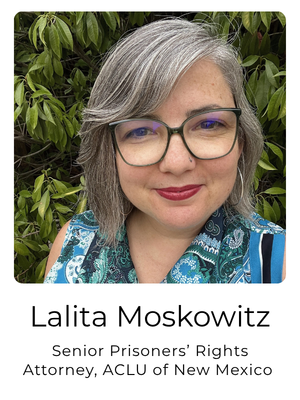
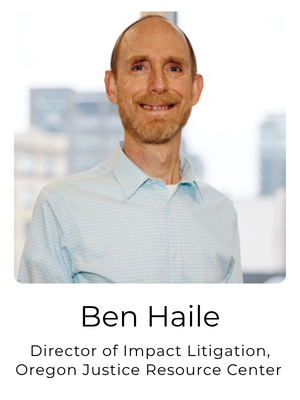
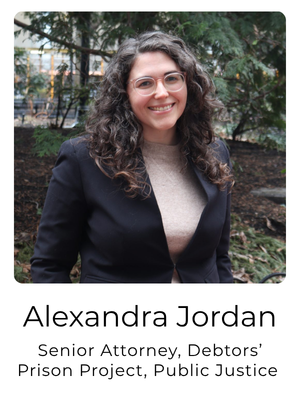
Panelist Biographies
- Greg Cui is a Counsel for the Supreme Court and Appellate Program at the MacArthur Justice Center. He identifies and litigates strategic civil rights and criminal justice cases in federal courts across the country, including the U.S. Supreme Court. His docket covers a broad range of issues, including qualified immunity, sovereign immunity, restrictions on federal habeas corpus, the Prison Litigation Reform Act, and state and federal constitutional law relating to prisons, policing, and punishment. As a senior attorney, Greg supervises case teams and trains junior attorneys serving as legal fellows. Greg also teaches a legal practice course at the University of Virginia School of Law.
Prior to joining MacArthur, Greg was an associate in the Supreme Court and Appellate practice group at Sidley Austin LLP. At Sidley, Greg briefed high-stakes appeals in federal court on a number of complex issues. He also led a team of pro bono attorneys who partnered with the National Immigrant Justice Center to bring a strategic lawsuit challenging the federal government’s detention of noncitizens in appalling conditions at a county jail in Indiana. For his work, NIJC honored Greg with the Rising Star Award in 2023.
Greg previously served as a law clerk to Justice Sonia Sotomayor of the U.S. Supreme Court. He also served as a law clerk to Judge William A. Fletcher of the U.S. Court of Appeals for the Ninth Circuit, and for Judge Jesse M. Furman on the U.S. District Court for the Southern District of New York. Greg earned his J.D. from Yale Law School and his B.A. from Rutgers University – New Brunswick.
- George Mills joined the Prison Law Office as a Staff Attorney in 2025. George previously was a fellow with the Supreme Court and Appellate Program at the MacArthur Justice Center. There, George litigated civil rights cases across the country with a focus on challenging the application of qualified immunity. George graduated from Harvard Law School in 2021. During law school, George participated in the Prison Legal Assistance Project and interned with the San Diego Public Defender and the MacArthur Justice Center. After law school, George clerked for Judge Anne E. Thompson on the U.S. District Court for the District of New Jersey, Judge Jacqueline Scott Corley on the U.S. District Court for the Northern District of California, and Judge Lucy H. Koh on the U.S. Court of Appeals for the Ninth Circuit. He was admitted to the California Bar in 2022.
- Lalita Moskowitz is the Senior Prisoners’ Rights Attorney at the ACLU of New Mexico, where she litigates conditions of confinement issues like healthcare, excessive force, access to books, and solitary confinement. Since passage of New Mexico’s Civil Rights Act in 2021, Lalita has been working toward stronger protections for incarcerated people under the state constitution. Lalita started her legal career with ACLU of NM as an Equal Justice Works Fellow working to address the unique challenges facing women in New Mexico’s prisons and jails. Before she graduated from the University of New Mexico School of Law in 2018, Lalita worked at ACLU of NM for two years as a law clerk for reproductive rights. Before law school, Lalita was a field organizer for Planned Parenthood of New Mexico and served as team leader for AmeriCorps NCCC. Lalita received her Bachelor of Arts from Connecticut College in 2012. She also is an adjunct professor at the University of New Mexico School of Law, where she teaches the course on prisoners’ rights. Among other things, Lalita is passionate about her many house plants, good music played loud, and exposing the compounding harms of mass incarceration.
- Ben Haile is the Senior Attorney for Impact Litigation at the Oregon Justice Resource Center. He focuses almost entirely on conditions of confinement in Oregon prisons. He is working to end the use of prolonged solitary confinement. This has included an administrative rule challenge, claims on behalf of people harmed by solitary, and an ongoing class action on behalf of all people in solitary confinement solitary confinement. Previously, he was a member of the Portland Law Collective, an egalitarian team of lawyers and legal workers that represented labor unions, progressive political organizations, activists, and prisoners. In the Collective, Ben led many wrongful death claims on behalf of families of people who died in prison. Ben began litigating civil rights cases in 2004.
Alexandra Jordan is a Senior Attorney with the Debtors’ Prison Project, based in Northern California. Before joining Public Justice, Alex was the Associate Vice President for Strategic Litigation at the Conservation Law Foundation (CLF) in Boston, Massachusetts, where she managed a team of several attorneys and paralegals on groundbreaking federal Clean Water Act cases against major fossil fuel companies. Prior to her time at CLF, Alex was a Senior Attorney with the Economic Justice Project at the Southern Poverty Law Center in Montgomery, Alabama, where she primarily litigated cases addressing economic and racial injustice in the criminal legal system.
After receiving her J.D., magna cum laude, from Harvard Law School, Alex clerked for the Honorable Catharine F. Easterly on the District of Columbia Court of Appeals.
Alex is admitted to practice law in California, Alabama, and Massachusetts, as well as numerous federal courts.
CLE Materials
- Jenkins-Millage v. Oregon Department of Corrections, No. 26CV29104 (July 22, 2026)
- E.L. v. Adams Cnty. Sheriff Gene Claps, No. 26SC522 (Colo. Sept. 8, 2026) [E.L. v. Claps, No. 2025-CV-31717 (Adams County Dist. Ct.)]
- Complaint (Oct. 28, 2025)
- Preliminary Injunction Motion (Oct. 25, 2025)
- Petition for Order to Show Cause (PFR) (Mar. 30, 2026)
- Amicus Brief (July 2, 2026)
- LaSeur v. Miller, 345 Or.App. 33 (2025)
- Sterling v. Cupp, 290 Or. 611 (Ore. 1981)
- New Mexico v. Huerta, Amicus Brief (Mar. 30, 2026)
- Atencio v. New Mexico, Amicus Brief (Jan. 30, 2026)
- Fusilier v. New Mexico Corrections Department, Complaint (May 8, 2025)
- Daugherty v. New Mexico Corrections Department, No. D-101CV2026-00745 (Mar. 17, 2026)
- OJRC v. ODOC, CA A177606 (Or. Ct. App. Sept. 14, 2022) [Opening Brief]
- Roberts v. Oregon, No. 23-cv-13593 (Or. Mar. 31, 2023) [Petition]
Suing the Carceral-Industrial Complex: Damages, Records, and Immunities Against Corporate Actors
This session focuses on holding corporate actors who run carceral facilities and programs accountable in court, organized around three recurring challenges. Damages: Monell and state-law tort theories against private contractors, forced-labor and consumer-protection / antitrust claims, and the mass-tort problem created when companies like Corizon/YesCare and Wellpath use bankruptcy and divisional-merger (“Texas Two-Step”) restructuring to try to escape § 1983 liability. Records: extracting discovery and public records from private contractors that claim exemption from transparency laws. Immunities: the double-edged private-actor liability landscape—where Richardson v. McKnight strips qualified immunity from privately employed prison guards, but Minneci v. Pollard forecloses a federal Bivens remedy, and defendants press Yearsley federal-contractor and state-action defenses.
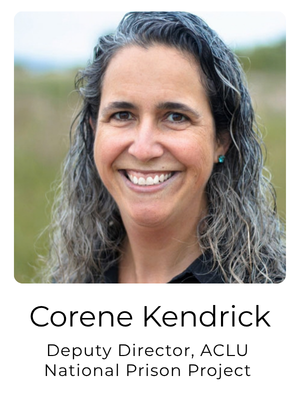
Panelist Biographies
- Corene Kendrick serves as deputy director of the ACLU’s National Prison Project, overseeing litigation and policy work to protect people held in prisons and jails throughout the United States. Before joining the ACLU in 2020, she practiced at the Prison Law Office, representing incarcerated people in class actions in California and Arizona. Her earlier work focused on children involved in foster care and juvenile justice: she handled litigation, policy initiatives, and public education at the Youth Law Center and served as a Skadden Fellow at Children’s Rights. Kendrick earned her law degree at Stanford, a master’s in public affairs at the University of Texas, and her undergraduate degree at George Washington University. She serves on the Pacific Juvenile Defender Center’s board.
- Jackie Aranda Osorno is a senior attorney at Public Justice whose work includes court transparency and access to justice. She has worked to open court proceedings to public scrutiny and to address barriers faced by people seeking accountability from powerful institutions. Her practice includes bankruptcy-related advocacy for incarcerated people, with attention to the practical difficulties they face in participating in court proceedings. She previously worked with the Southern Poverty Law Center’s Immigrant Justice Project. Aranda Osorno graduated from Berkeley Law in 2015, where she participated in the Death Penalty Clinic.
- Caroline Cohn is a staff attorney with the National Consumer Law Center, where she uses consumer law to address financial harms experienced by people affected by the criminal legal system and their families. Her work covers court debt, barriers created by background screening, and charges imposed by companies providing services to people in custody, including telephone calls, commissary purchases, and money transfers. She combines litigation with research and advocacy before legislatures and agencies. Cohn joined NCLC as an Equal Justice Works Fellow and has co-authored reports examining how court debt obstructs record clearing and how sealed or expunged court records affect housing and employment. She previously clerked for Judges Carolyn McHugh and Carol B. Amon. She holds degrees from Stanford Law School and the University of Pennsylvania.
Sarah Grady is a partner and co-founder of Kaplan & Grady. Her practice centers on people harmed while incarcerated and the families of those who died in custody. She handles trials and appeals involving medical and mental-health care, excessive force, sexual abuse, and other civil-rights violations, pursuing claims against both public officials and private companies. Before founding the firm, Grady created and directed the Prisoners’ Rights Project at Loevy & Loevy. She also advises and trains attorneys working on prisoners’ rights cases and co-teaches the Civil Rights Litigation Clinic at Northwestern’s MacArthur Justice Center. Grady serves on the boards of the Illinois Prison Project and Uptown People’s Law Center. She graduated from Northwestern University School of Law and the University of Iowa.
CLE Materials
- Ariel Nelson, et al., Nat’l Consumer L. Ctr., Commercialized (In)Justice Litigation Guide (2020).
- Consumer Fin. Prot. Bureau, Justice-Involved Individuals and the Consumer Financial Marketplace (2022)
- Rebecca Cooley, Working While Detained: Litigating One-Dollar-Per-Day “Voluntary” Labor in U.S. Immigration Detention, 114 Calif. L. Rev. (forthcoming 2026)
- Micaela Gelman, Mismanaged Care: Exploring the Costs and Benefits of Private vs. Public Healthcare in Correctional Facilities, 95 N.Y.U. L. Rev. 1386 (2020)
- Peyton Holahan, The Perils of Privatization: Exploring the Side Effects of Privatized Correctional Health Care in Favor of a Public Delivery Model, 29 Wash. & Lee J. Civ. Rts. & Soc. Just. 329 (2023)
- Smith v. Aramark, 2:25-cv-00710 (S.D.W.Va.) (complaint and order denying motion to dismiss).
- Stephen Raher, The Company Store and the Literally Captive Market: Consumer Law in Prisons and Jails, 17 Hastings Race & Poverty L.J. 3 (2020)
- August M. Ryan, Into the Black Hole: Private Prison Contractors and the Inspection of Public Records Act, 56 N.M. L. Rev. 449 (2026) (The Records segment)
- Grecia Victoria Sarda & Amanda J. Peters, The Private Prison Industry’s Unwarranted § 1983 Benefits, 76 Ala. L. Rev. 1 (2024) (The Immunities segment: Richardson/Minneci/state-action architecture. Note: co-authored — earlier drafts of our details doc credited Peters alone.)
- Lindsey D. Simon, Bankruptcy Grifters, 131 Yale L.J. 1154 (2022) (The Texas Two-Step / non-debtor release framework behind the Corizon/YesCare and Wellpath fights; predates Purdue — panel to update live.)
- Lisa Johnson-Barker v. Wexford Health Sources, No. 1:20-cv-05913 (W.D. Pa.)
- Complaint (Aug. 17, 2026)
- Plaintiff’s Motion for Preliminary Injunction (Sept. 10, 2026)
- Brief in Support of Preliminary Injunction (Sept. 10, 2026)
- Caroline Cohn, UDAP Challenges to Prison Financial Exploitation, NCLC (Oct. 12, 2026)
Using APA Claims to Enforce the Rights of People in BOP Custody
In this session, panelists will discuss using the Administrative Procedure Act to enforce the rights of people incarcerated in the Federal Bureau of Prisons.
Panelist Biographies
- Sarah K. Austin joined GLAD Law as a Staff Attorney in May 2024 and brings a passion for civil rights and complex civil litigation. She graduated with Order of the Coif honors from UCLA School of Law, where she served as an editor for the UCLA Law Review. Prior to joining GLAD Law, she was an associate at a leading civil rights firm in Maine, representing plaintiffs in employment discrimination and police misconduct cases. She also spent a year representing low-income individuals at Pine Tree Legal Assistance in Maine, focusing on eviction proceedings and related civil matters. Sarah held previous roles as a law clerk for Judge William J. Kayatta, Jr., on the First Circuit U.S. Court of Appeals, and for Chief Judge Jon D. Levy on the Maine U.S. District Court.
- D. Korbin Felder is a Staff Attorney at the Center for Constitutional Rights. He is based in Jackson, Mississippi, and is part of the CCR South. His work focuses on challenging state violence, advancing racial justice movements in the South, and advocating on behalf of people inside prisons, jails, and detention centers across the South. Before coming to the Center for Constitutional Rights, he spent years challenging abusive and unconstitutional conditions within prisons and jails, advocating for people before state parole boards, and providing reentry support for people coming home from incarceration. Korbin is a graduate of the University of Michigan and the UCLA School of Law, where he obtained a dual J.D./M.A. in African-American Studies. Korbin clerked for the Honorable Carlton W. Reeves of the U.S. District Court for the Southern District of Mississippi. He is licensed to practice in Mississippi.
Zoé Friedland is a supervising staff attorney at the Public Defender Service for the District of Columbia. Prior to that role, she was on the Social Justice and Impact Litigation team at the Santa Clara County Counsel’s Office. She clerked on the United States District Court for the District of Columbia and the United States Court of Appeals for the D.C. Circuit. Zoé graduated from Stanford Law School and Dartmouth College.
Maria Morris is a Senior Staff Attorney with the ACLU’s National Prison Project, where she litigates on behalf of people incarcerated throughout the country. She has extensive experience in the field. She led the successful litigation against the Alabama Department of Corrections for its failure to provide constitutionally adequate mental health care and accommodations for persons with disabilities. She was also a member of the overcrowding trial team in Brown v. Plata.
Prior to joining the ACLU, Maria was a Supervising Staff Attorney the Southern Poverty Law Center, an associate with Rosen, Bien, Galvan & Grunfeld, LLP, and a law clerk Judge William Canby of the 9th Circuit Court of Appeals. Maria graduated from Emory University School of Law and Barnard College.
Laura Rovner (she/her) is a Professor of Law and the founding Director of the Civil Rights Clinic at the University of Denver Sturm College of Law. Through the clinic, she supervises law students representing incarcerated clients in constitutional litigation about prison conditions including indefinite solitary confinement, denial of outdoor exercise, lack of adequate medical and mental health care, and restrictions on religious freedom. Professor Rovner lectures and writes frequently about the rights of people incarcerated in prisons and jails. Her scholarship has or will appear in the Virginia Law Review, the American University Law Review, the Utah Law Review, the UCLA Criminal Justice Law Review, and the Correctional Law Reporter, among others. She has provided expert testimony before the European Court of Human Rights about conditions of confinement in the federal supermax prison, served as affiliated faculty with the US-European Criminal Justice Innovation Program in Oslo, Norway, and served on the Colorado legislature’s Work Group on Serious Mental Illness in Long-term Isolated Confinement. She has provided expert commentary on prison and detention issues for national and international media outlets, including The Washington Post, VICE, The Nation, The Daily Beast, and The Marshall Project, and has been solicited as an amicus curiae for cases involving prison law and prisoners’ rights in courts around the country. Her 2018 talk at TEDxMileHigh – What happens to people in solitary confinement – was selected for inclusion on the TED website and has been viewed over 2.4 million times.
CLE Materials
- Doe v. Blanche (various documents in a consolidated PDF)
- Kingdom v. Trump (various documents)
- Love v. BOP (various documents)
- Taylor v. Trump (various documents)
- Steven D. Gordon, Expanding the Administrative Record in APA Litigation, 1 J. Fed. Action 275 (2023)
Prison Law & Advocacy Conference
Nov. 5–7, 2026
Harvard Law School
Prison Legal Assistance Project
1585 Massachusetts Ave.
Cambridge, MA 02138
Questions? 26PLAC@gmail.com
Prison Law & Advocacy Conference
Nov. 5–7, 2026
Harvard Law School
Prison Legal Assistance Project
1585 Massachusetts Ave.
Cambridge, MA 02138
Questions? 26PLAC@gmail.com
Prison Law & Advocacy Conference
Harvard Law School
Prison Legal Assistance Project
1585 Massachusetts Ave.
Cambridge, MA 02138
Nov. 5–7, 2026
Questions?
26PLAC@gmail.com